
Reviewed · COOKING CLASSES
Small-Group Khinkali and Khachapuri Cooking Class in Tbilisi
Tbilisi’s most useful food lesson is also one of its tastiest: you learn to fold khinkali, Georgia’s soup-filled dumplings, and prepare Imeretian khachapuri, the country’s round cheese bread. The setting is casual, the food is substantial, and a glass of Georgian wine helps turn the class into a social meal.
I like the central downtown location and the low $27.50 price, which covers wine, cheese, salad, and the dishes you help prepare. I also like that the instructors, including Seva, Artem, and Vladimir in different sessions, explain the folding technique with humor and patience.
The main caution is the format. This is held at a restaurant table, not inside the kitchen, and class sizes have sometimes exceeded the advertised limit of six. Much of the hot cooking is handled by the restaurant staff, so you are taking a guided food workshop rather than running every step yourself.
In This Review
- Key points before you book
- Two Georgian classics on one plate
- What happens during the two-hour class
- A restaurant table, not a cooking kitchen
- Wine, cheese, salad, and a proper meal
- The instructors make the difference
- Group size deserves careful attention
- Why the $27.50 price is attractive
- Timing, location, and practical details
- Who will enjoy this class most
- Should you book the Tbilisi khinkali and khachapuri class?
- FAQ
- How long does the cooking class last?
- What dishes will I learn to make?
- Is the class held in a kitchen?
- What food and drinks are included?
- Where does the experience begin and end?
- How many people are in the class?
- Can I cancel for a refund?
Key points before you book
- Khinkali folding is the hands-on highlight: You prepare or help with the filling, then practice the traditional pleated shape.
- Imeretian khachapuri is the second main dish: You work with the dough, filling, and cheese before the bread is finished.
- Wine and a full spread are included: Expect Georgian wine, tomato salad, farm cheese, khinkali, and khachapuri.
- The class meets at St. Bunny31 on Griboedov Street: It begins and ends at this central Tbilisi location.
- The advertised group limit may vary: Some sessions have been intimate, while others have included 9, 10, 13, or more people.
- The kitchen is off-limits to participants: The class takes place in the restaurant hall, with the final cooking done behind the scenes.
Two Georgian classics on one plate
This class focuses on two dishes you will see everywhere in Georgia, but making them gives you a better sense of how they work.
Khinkali are dumplings made from dough wrapped around a seasoned filling. The filling may be veal, cheese, or mushrooms. Properly cooked khinkali hold hot juices inside, so the familiar Georgian eating method matters: bite carefully, sip the broth, then eat the dumpling.
The folding lesson is the most distinctive part of the class. You learn how to gather the dough into the familiar cinched top while the cook explains the small details that make the shape hold together. It looks simple when an experienced cook does it. Your first few may look a little uneven, which is part of the fun.
Khachapuri is Georgia’s famous cheese bread. This session uses the Imeretian style, a round bread filled with cheese, rather than the boat-shaped Adjarian version commonly seen in photographs. You prepare the dough and filling, spread the cheese, and help bring the bread to readiness.
The difference between these dishes makes the class work well. Khinkali asks for careful shaping and coordination. Khachapuri is more about dough, cheese, and getting the proportions right. You leave with two techniques that are easy to remember and useful if you want to recreate Georgian food at home.
A few more Tbilisi trips to weigh up
What happens during the two-hour class
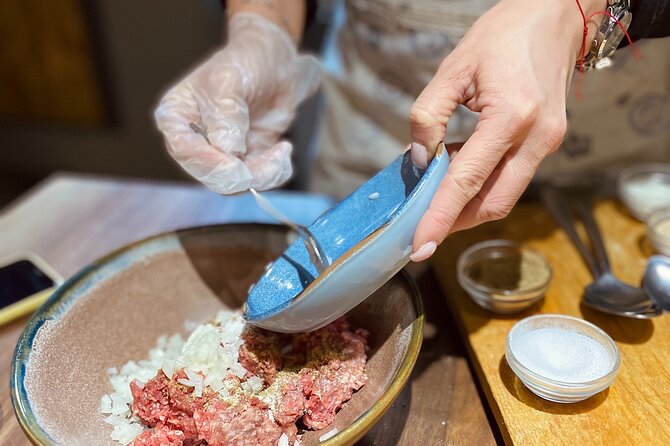
The session begins with an explanation of the dough and the basic method for each dish. The cook talks through the khinkali dough and shows how the khachapuri filling comes together.
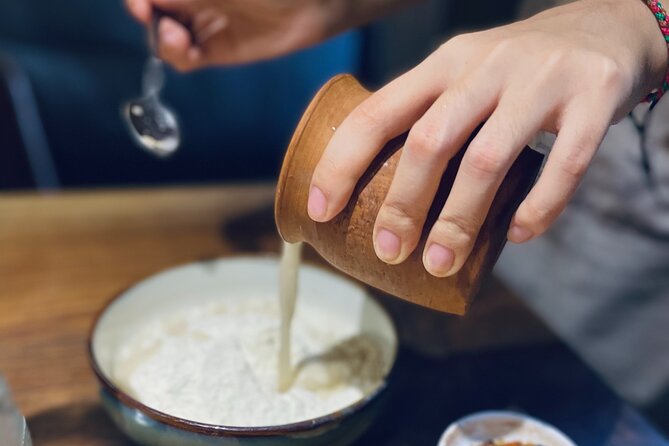
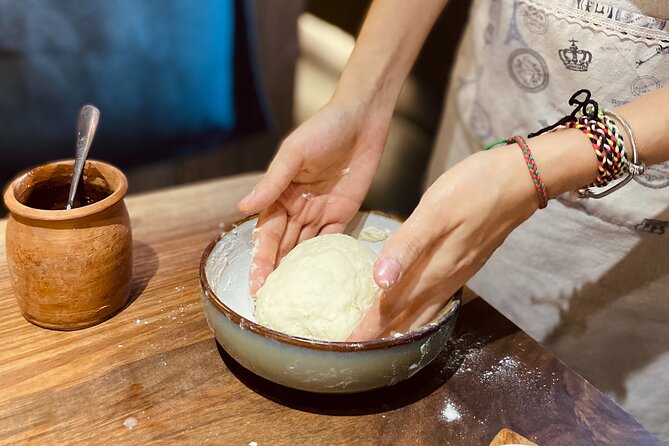
You then work on the khachapuri. The practical steps include preparing the dough and filling, spreading the cheese, and getting the bread ready for cooking. The class is designed for beginners, so you do not need prior cooking experience.
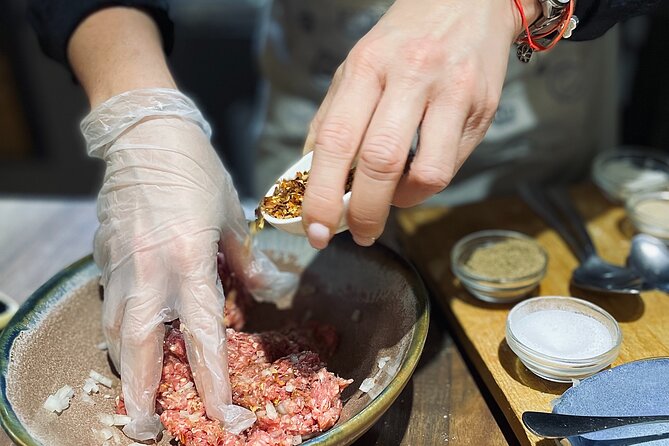
The khinkali portion follows with the filling and folding technique. Depending on the session, you may help prepare the filling and then take turns shaping the dumplings. The instructor talks through cooking details, along with stories about Tbilisi and Georgian food customs.
One useful point to understand before booking: the advertised description presents the class as a lesson in making the dishes, but the actual level of hands-on work can vary. Several sessions have used dough prepared in advance, particularly for khinkali, and the restaurant staff may cook the finished food in the kitchen.
That does not make the class pointless. You still learn the key shaping skills and see how the recipes are assembled. But if you want to knead every piece of dough, cook each dumpling yourself, and work beside the chef at the stove, this is not that kind of class.
A restaurant table, not a cooking kitchen
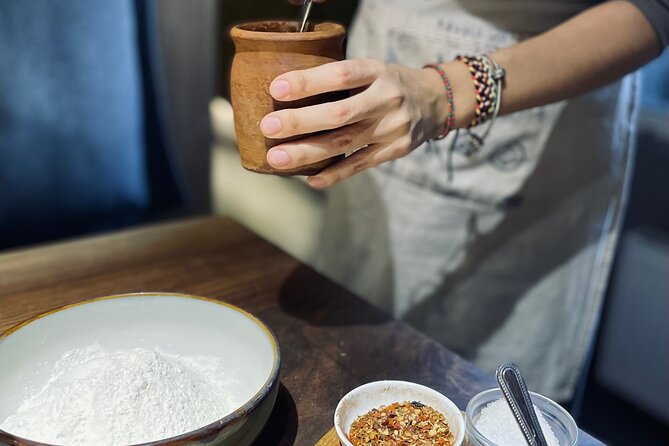
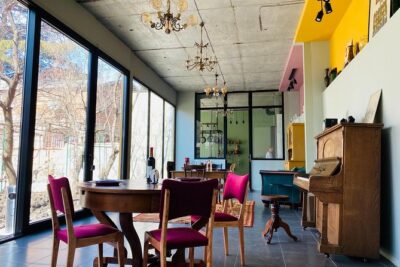
The setting is important. The class takes place in the restaurant hall at St. Bunny31, not in the kitchen. You sit around a table, receive instructions, and work with the ingredients there.
This arrangement has some clear benefits. You are comfortable, the class stays social, and you finish at the same table where you eat. The restaurant setting also makes the $27.50 cost practical, since the activity doubles as a meal.
The tradeoff is that you do not see every hot step. The restaurant kitchen handles boiling or baking, then brings the finished food back to the table. The instructor can explain timing and temperature, but you will not personally manage those parts.
For me, the difference is simple: book this for shaping, assembling, tasting, and learning the basics. Do not book it expecting professional kitchen access or a fully independent cooking lesson.
The restaurant format also means some people have had waiting periods between steps. Staff need to bring ingredients, clear space, and return with cooked food. A well-organized session can feel relaxed and sociable. A crowded or poorly timed one can feel slow.
Wine, cheese, salad, and a proper meal
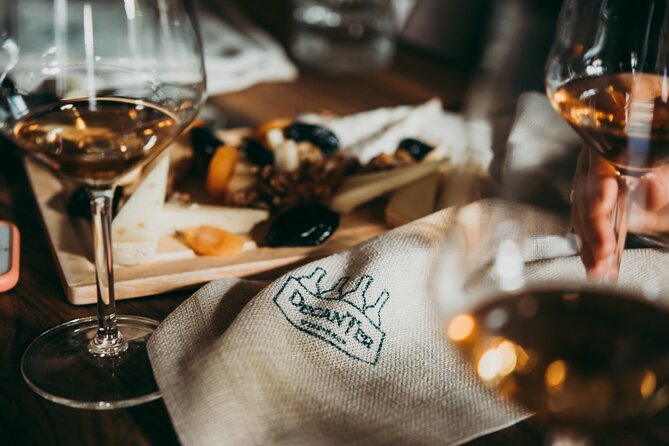
The food served around the lesson is one of the experience’s strongest points. You receive Georgian wine, a vegetable salad made with Georgian tomatoes, and a plate of farm cheeses.
The wine helps set the tone. This is not a silent demonstration followed by a quick taste. You have time to talk with the people at your table, listen to Georgian stories, and enjoy the meal as it comes together.
The salad and cheese also matter because khinkali and khachapuri are filling. By the end, you are not simply sampling two bites. The finished dishes, along with the side plates, amount to a full lunch or dinner for many people.
Portions can become less generous when the class is larger. Shared salad and cheese plates have felt small in some crowded sessions, so I would arrive ready to eat the main dishes rather than count on the sides to carry the meal.
Wine selection may also be limited. One account specifically noted that only red wine was offered, with no choice between red and white. If you cannot drink red wine, ask about the available option before the class begins.
Same mountains, a completely different kind of day:
- Day Trip to Kakheti Wine Region Including 9 Wine Tastings
★ 5.0 · 2,774 reviews - Highlights of Caucasus Mountains-Jinvali,Ananuri,Gudauri,Kazbegi(Group tour)
★ 5.0 · 2,682 reviews - Day Trip to Kazbegi and Gudauri
★ 5.0 · 2,009 reviews - Day Trip to Mtskheta Gori and Uplistsikhe
★ 5.0 · 1,801 reviews
The instructors make the difference
The cooking itself is straightforward. The personality and clarity of the instructor often determine how much you enjoy the two hours.
Seva, also written as Sewa in some feedback, is described as an easygoing and patient teacher who explains khinkali, khachapuri, Georgian feasts, and the traditions behind toasting. Artem has led sessions with historical background and a friendly approach. Vladimir has been praised for making an evening lively and welcoming.
The names matter because the experience is not a fixed performance delivered in exactly the same way every time. The guide may spend more time on Tbilisi stories, food origins, jokes, or practical technique depending on the group.
English is the offered language. Instructions have generally been easy to follow, though one session described the chef’s English as only reasonably strong. If a point is unclear, ask for a demonstration. Folding dough is easier to understand by watching hands than by hearing a long explanation.
The best part of the teaching is its patience. Complete beginners can manage the basic shapes, and children have taken part with adults. The class also works well for solo visitors because the shared table gives you an easy way to meet people without arranging a separate food tour.
Group size deserves careful attention
The experience is advertised for a maximum of six people. That is a major reason to consider it, since a six-person table allows more time with the instructor and more chances to handle the food.
Actual sessions have not always followed that limit. Some bookings have had only two participants, while other classes have included 9, 10, 13, or even larger groups. One account described a session of roughly 25 people and outdoor seating in hot weather.
A small group changes the value of the class. With two or three people, you can make more of the food and ask questions without waiting. With a larger group, you may take turns with the dough or filling, and not everyone gets equal hands-on time.
The provider has acknowledged that busy periods can bring larger groups. That means you should treat the six-person limit as something to confirm rather than an absolute guarantee. If the group size is central to your decision, contact the provider before paying.
Larger groups are not automatically bad. You may enjoy the extra conversation and shared atmosphere. Still, the advertised price feels strongest when the class remains intimate and the food is divided among a modest number of people.
Why the $27.50 price is attractive
At $27.50 per person, this is inexpensive for a central Tbilisi activity that includes instruction, wine, cheese, salad, and a filling meal.
I see the price as especially good if you want a short activity between sightseeing stops. The class lasts about two hours, begins and ends at the meeting point, and does not require a long ride outside the city.
The value is less clear if you judge cooking classes by the amount of independent kitchen work. You are paying for a food lesson and social meal, not a full chef-led production in which each person cooks from raw ingredients through the final hot stage.
The price also helps balance the occasional organizational problems. A delayed start or a long wait is frustrating at any cost, but it is easier to accept when the activity remains one of the cheaper ways to eat well and learn a local skill in central Tbilisi.
Timing, location, and practical details
Meet at St. Bunny31, 31 Griboedov Street, in downtown Tbilisi. The activity ends at the same place, so you can plan another central stop afterward without arranging a separate return transfer.
The location is near public transportation. The ticket is mobile, and confirmation is provided at booking. Service animals are allowed.
Plan on roughly two hours, though some sessions have run longer, especially when dining and delays are included. If you have a train, airport transfer, or timed museum entry immediately afterward, leave extra space.
Come hungry, but not so hungry that you are uncomfortable while waiting for the food to cook. The class includes cheese, salad, wine, khinkali, and khachapuri, and the finished meal can be substantial.
The activity is suitable for families, including at least one booking with children aged two and eight. Very young children may not take part in every shaping step, but the shared meal and simple dough work can still make this a good family outing.
Free cancellation is available up to 24 hours before the start time. Changes or cancellations made less than 24 hours in advance are not refunded.
Who will enjoy this class most
I would choose this experience if you want an affordable introduction to Georgian food and prefer eating what you make. It suits first-time visitors who want more than a restaurant meal but less commitment than a long culinary course.
It is also a good match for solo visitors, couples, families, and friends who enjoy a relaxed table setting. The wine and shared dishes create an easy social rhythm, and the class gives you something to talk about even if you arrive knowing nobody.
You may want a different activity if you are a serious home cook seeking precise instruction on every stage. The lack of kitchen access and the possibility of pre-prepared dough limit the technical depth.
I would also hesitate if you dislike uncertain group sizes. The difference between two participants and 13 participants is substantial, especially when everyone is sharing ingredients and waiting for the restaurant kitchen.
Should you book the Tbilisi khinkali and khachapuri class?
Book it if you want a friendly, low-cost food experience in central Tbilisi, with enough cooking to learn the signature shapes and enough food to make a meal. The strongest reasons are the price, the two famous Georgian dishes, the wine and side plates, and instructors who tend to bring patience and humor to the table.
Before booking, confirm the expected group size and ask how much dough preparation will be done by participants. If you receive the small-group format described, this is an excellent value. If the class is crowded, think of it as a Georgian cooking demonstration with shared practice rather than a full kitchen workshop.
FAQ
How long does the cooking class last?
The scheduled duration is approximately two hours. Some sessions have lasted longer when delays and dining time were included.
What dishes will I learn to make?
You will learn about khinkali and Imeretian khachapuri. Khinkali may be filled with veal, cheese, or mushrooms, while Imeretian khachapuri is a Georgian cheese-filled bread.
Is the class held in a kitchen?
No. The workshop takes place in the restaurant hall at a table. The restaurant kitchen handles the hot cooking, including boiling or baking the prepared food.
What food and drinks are included?
The experience includes Georgian wine, a vegetable salad, farm cheeses, khinkali, and khachapuri that you help prepare.
Where does the experience begin and end?
It begins at St. Bunny31 on Griboedov Street in Tbilisi and ends back at the same meeting point.
How many people are in the class?
The stated maximum is six participants, but some sessions have been larger, with reported groups of 9, 10, 13, or more people. Confirm the expected group size if this matters to you.
Can I cancel for a refund?
You can cancel for a full refund up to 24 hours before the scheduled start time. Cancellations or changes made less than 24 hours in advance are not refunded.
Just added around Tbilisi
- Private Adorable City Tour of Tbilisi★ 5.0 · 3 reviews
- Old tbilisi walking tour & wine tasting★ 5.0 · 9 reviews
- Tbilisi Airport to Gudauri, Bakuriani, Batumi, Tbilisi★ 5.0 · 3 reviews
- Your unique photo session in Tblisi, Georgia★ 3.5 · 4 reviews
- full day Kazbegi-Gudauri-jvari -from Tbilisi★ 5.0 · 6 reviews
- Wine promenade in hospitable Tbilisi★ 5.0 · 17 reviews
- Vardzia. Lake Paravani, Khertvisi & Lomisa castle, Rabati★ 4.5 · 12 reviews
- Wine Tasting Tour in Georgia’s Cradle of Wine★ 5.0 · 12 reviews
Cooking Classes, compared.
Nana’s Kitchen – traditional Georgian cooking class at real Georgian family home
Read our review →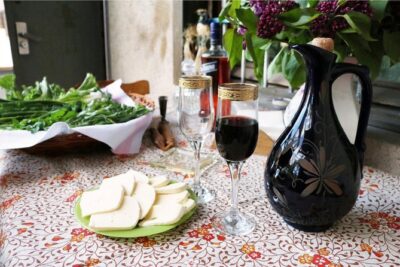
Join a Local for a Market Tour, Cooking Class and Meal in her Tbilisi Home
Read our review →
Taste of Georgia. Cooking-Class Khinkali, Khachapuri and more
Read our review →
Exploring Heritage and Cuisine through Cooking Classes
Read our review →
Private Cooking Class with a Tbilisi Food and City Expert Dinara
Read our review →
7-Day Georgian Wine and Culinary Private Tour with Cooking Class
Read our review →
Enjoy a Traditional Georgian Cooking Class and Meal with a Local in Tbilisi
Read our review →Browse the lists this tour appears in