

Reviewed · WALKING TOURS
Walking Tour Tbilisi: From the USSR to the 1st Female President
Georgia’s modern political story comes into focus on this short walk from Parliament to the House of Justice. Instead of treating Tbilisi as a collection of pretty buildings, the tour links specific sites to the country’s move from Soviet rule toward its current political system, including the story of Georgia’s first female president.
I like the small private format, which gives you room to ask questions rather than listen to a fixed speech. I also like the efficient route: Parliament, a scenic park, the Presidential Palace, and the House of Justice give you a clear framework in less than an hour. The main drawback is that you do not enter any buildings, and the short duration means this is an introduction, not a full political history course.
In This Review
- Key points
- What This Tbilisi Walk Actually Teaches You
- Starting at Parliament on Rustaveli Avenue
- The Park and April 9, 1989
- Why Georgia Has Two Presidential Palaces
- Finishing at the House of Justice
- The Guide Makes the Short Format Work
- What the Private Format Means for Value
- Walking Conditions and Practical Planning
- Who Will Get the Most From This Tour
- How I Would Fit It Into a Tbilisi Visit
- Should You Book the Parliament to House of Justice Walk?
- FAQ
- How long does the walking tour last?
- Where does the tour begin?
- Where does the tour end?
- Is the tour offered in English?
- Do you enter Parliament, the Presidential Palace, or the House of Justice?
- Is this a private tour?
- What happens if the weather is poor?
Key points
- Start at Parliament: Meet at 8 Shota Rustaveli Avenue and begin with the center of Georgian democracy.
- April 9, 1989: A walk through the park connects the city’s public space with a major event in Georgia’s modern past.
- Two presidential palaces: Learn why Georgia has two and why the first female president moved to Orbeliani Palace in 2018.
- End at the House of Justice: The final stop ties Georgia’s legal system to its present political reality.
- Guide Irakli: His role is central to the experience, with clear explanations and time for questions.
- Fast, focused format: Plan on 45 minutes to one hour, in English, with a moderate amount of walking.
What This Tbilisi Walk Actually Teaches You
Tbilisi offers plenty of tours about churches, balconies, food, and old streets. This one takes a different route. It focuses on the institutions and public places that help explain how Georgia works today.
You begin in front of Parliament and walk toward the House of Justice. Along the way, the guide places each stop in a political setting. The result is a compact lesson in Georgia after the Soviet period, told through buildings you can see rather than through a long classroom-style talk.
I find that approach useful early in a visit. If you know little about Georgia’s recent political development, the country can be difficult to read. The names, institutions, and changes in government may seem disconnected. This walk gives you a basic map so later conversations, museum visits, or news reports make more sense.
The tour is not designed as a general sightseeing walk. You will not get a broad survey of Tbilisi’s architecture, food scene, religious sites, or older history. Its value comes from its narrow focus and the chance to ask direct questions in a private setting.
A few more Tbilisi trips to weigh up
- Tbilisi Walking Tour Including Cable Car and Traditional Bakery
★ 5.0 · 1,310 reviews - Tbilisi:Evening Walking & Talking Tour with Wine & Boat Ride
★ 5.0 · 572 reviews - Old Tbilisi Highlights walking tour with wine & 10 tastings
★ 5.0 · 276 reviews
Starting at Parliament on Rustaveli Avenue
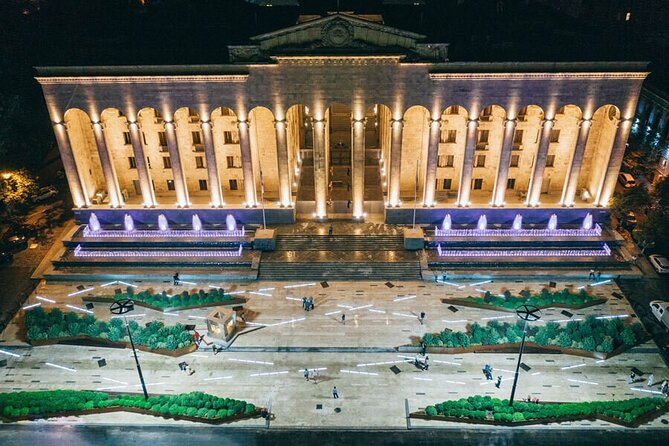
The meeting point is in front of the Parliament of Georgia at 8 Shota Rustaveli Avenue. That gives the tour a fitting beginning. Parliament is not simply a grand city building in this context. It is the place where the conversation about Georgian democracy starts.
Your guide, Irakli, introduces the political setting before leading you onward. The information supplied for the tour does not promise entry to Parliament, so expect to view the building from outside. That is important if you hoped for an interior visit or a formal tour of the institution.
This first stop should be especially useful if you want to understand how public buildings function as symbols. The tour treats Parliament as part of Georgia’s democratic story, not as a detached monument. You’ll hear about political developments since the fall of the Soviet Union and how those changes shaped the country.
A private guide can make a real difference here. You can ask about terms you do not understand, request more detail about a particular period, or steer the conversation toward the questions that matter most to you. The experience is available in English, so it suits visitors who want political context without relying on a translated lecture.
The Park and April 9, 1989
The route continues through a scenic park, where the subject turns to April 9, 1989. The tour uses this public space to explain the events of that date and their place in Georgian history.
The supplied details do not spell out every event covered, so you should not expect a full chronology of the period. Instead, this stop offers a focused explanation of why April 9 matters and how it connects to Georgia’s later political development.
This is one of the strongest parts of the route because it joins a physical place with a date that can otherwise remain abstract. You are not only hearing a year and a political label. You are standing in the city while the guide explains the forces that shaped Georgia’s path away from Soviet rule.
The park also gives the walk a change of pace. Parliament is an institutional starting point. The park creates room for a broader discussion about public life, memory, and the role of shared city spaces. Since the entire tour is outdoors, weather matters. Poor weather can lead to a new date or a full refund, and you should dress for a walk rather than a building visit.
Why Georgia Has Two Presidential Palaces
The Presidential Palace section is the most distinctive feature of the tour. You learn why Georgia has two presidential palaces, then hear why the country’s first female president moved to Orbeliani Palace in 2018.
That is a useful subject because it moves beyond a standard photo stop. A palace can look impressive from the street, but its political meaning is less obvious. The guide explains how the two sites relate to the office of the president and why the move to Orbeliani Palace became part of Georgia’s political story.
You will see the palace from outside. The tour does not include entry to the building, and that limitation should be clear before you book. If you want grand interiors, official rooms, or a museum-style visit, this is not the right format. If you want the reason behind the buildings and their use, the stop earns its place.
The focus on the first female president also gives the tour a human angle. Rather than discussing only offices and constitutional structures, it connects the presidential institution to a specific change in Georgia’s political life. Irakli’s job here is to explain the setting without turning the walk into a partisan campaign talk.
Same mountains, a completely different kind of day:
- Day Trip to Kakheti Wine Region Including 9 Wine Tastings
★ 5.0 · 2,774 reviews - Highlights of Caucasus Mountains-Jinvali,Ananuri,Gudauri,Kazbegi(Group tour)
★ 5.0 · 2,682 reviews - Day Trip to Kazbegi and Gudauri
★ 5.0 · 2,009 reviews - Day Trip to Mtskheta Gori and Uplistsikhe
★ 5.0 · 1,801 reviews
Finishing at the House of Justice
The walk ends at the House of Justice on the right bank of the Mtkvari River, at 1 Zviad Gamsakhurdia Named Right Bank. This is a practical finish because the building represents another side of public life: the legal and administrative system that affects ordinary people.
At this stop, you learn about key parts of Georgia’s legal system and its role in shaping present-day politics. The tour does not promise an interior visit, so once again, think of this as an outside explanation connected to the building rather than a guided inspection inside it.
The House of Justice gives the tour a useful closing point. Parliament represents political decision-making. The Presidential Palace represents the head of state. The House of Justice brings the discussion toward law and public administration. Together, the stops create a simple structure for understanding the country’s institutions.
This final location may also help you plan the rest of your day. Since the start and finish are different, you should not expect to return to Parliament with the group. The listing identifies both points clearly, so check the map before setting out and allow time to reach the starting point.
The Guide Makes the Short Format Work
A 45-minute to one-hour tour can easily feel rushed. Here, the limited number of stops keeps the route manageable. The key is the guide’s ability to explain the connections between them without wandering into unrelated subjects.
Irakli is described as an attentive guide and a pleasant conversationalist who answers questions. That matters more on a political tour than on a simple landmark walk. Political terms can be confusing, and Georgia’s modern changes are not always easy to place on a timeline. You need someone who can adjust the explanation when you ask for clarification.
The tour seems designed around conversation rather than a long memorized speech. That does not mean every subject can receive equal attention. In one hour, you will get a strong introduction, not a full account of Georgia’s twentieth and twenty-first centuries.
I would arrive with two or three questions in mind. You might want to ask about the transition after the Soviet Union, the role of the president, the reason for two palaces, or the legal system represented by the House of Justice. A private tour gives you a better chance to shape the discussion around those interests.
What the Private Format Means for Value
No price is provided in the information available here, so I cannot judge the exact cost. I can judge what you receive for the time: a private guide, English-language explanations, a central walking route, and a chance to ask questions without sharing the experience with a larger group.
That can be good value if political context is important to you. A one-hour orientation may help you understand the rest of your stay in Tbilisi and Georgia. It is less compelling if you mainly want famous sights, interior access, or a long walking tour through several neighborhoods.
The private format is also helpful for couples, families, or friends with different levels of background knowledge. One person can ask basic questions while another asks about constitutional or political details. The tour is not limited to a fixed public group, so the pace can feel more personal.
Still, do not confuse private with extensive. The route remains short, and the buildings remain exterior stops. The value comes from interpretation, not from the number of sights or the amount of time spent at each one.
Walking Conditions and Practical Planning
The tour requires a moderate level of physical fitness. The information does not give an exact distance, number of steps, or accessibility details, so you should be ready for a normal city walk between the named locations.
Wear comfortable shoes and prepare for outdoor conditions. The experience depends on good weather, and poor weather can cause a cancellation with either a different date or a full refund. Since the tour lasts less than an hour, it is easy to fit into a morning or afternoon, but leave enough time to find Parliament before the scheduled start.
A mobile ticket makes arrival simple. The tour is near public transportation, though the supplied details do not specify a particular bus, metro stop, or route. Use the exact Parliament address when planning your arrival rather than relying only on the tour title.
The ending at the House of Justice is useful to know in advance. If you have a restaurant booking or another activity immediately afterward, build in a little flexibility. The stated duration is approximate, and the amount of time spent answering questions can affect the pace.
Service animals are allowed. The activity is private, but the information does not give a maximum group size, so larger parties should confirm suitability when booking.
Who Will Get the Most From This Tour
I would recommend this walk to you if you want to understand present-day Georgia rather than only see its postcard views. It is a particularly good fit at the start of a visit, when you are still trying to place the country’s institutions, political changes, and public figures.
It also suits people who enjoy asking questions. The strongest benefit is not simply walking from one address to another. It is the opportunity to stop and ask why a palace moved, how the presidential role fits into the state, or why April 9 remains important.
The tour may also work well for repeat visitors. If you have already seen Tbilisi’s main churches and old streets, this offers a different way to read the city.
I would be more cautious if you want a broad introduction to all of Tbilisi. This is not a food tour, an architecture tour, or a complete city orientation. It does not include interiors, and its subject is modern politics. Visitors with no interest in government or recent history may find the focus too narrow.
How I Would Fit It Into a Tbilisi Visit
Book it early in your stay if you want a framework for the country. The route is short enough that you can place it beside other activities without giving up half a day.
After the tour, you may look at Georgian institutions differently. Parliament, the Presidential Palace, and the House of Justice will no longer be only buildings on a map. You will have heard how each one relates to the country’s political system.
Because the walk ends away from its starting point, it can also be paired with plans on the right bank. The supplied information does not identify nearby attractions or restaurants, so I would not build a detailed post-tour route without checking the map yourself.
The best preparation is modest. Read a basic outline of Georgian modern history, bring questions, and expect an outdoor conversation. You do not need specialist knowledge. The tour is meant to give you context, and the short format keeps the material approachable.
Should You Book the Parliament to House of Justice Walk?
Book this tour if you want a focused explanation of Georgia’s modern political life and value a private guide over a long list of sights. Irakli’s conversational approach, the April 9 stop, and the unusual explanation of Georgia’s two presidential palaces give the hour a clear purpose.
Skip it if your priority is entering historic buildings, seeing a wide range of Tbilisi attractions, or taking a leisurely full-city walk. You will remain outside, walk for less than an hour, and cover only a few locations.
For the right audience, this is a smart use of a spare hour. It gives you a clearer sense of how Georgia moved beyond the Soviet period and how its institutions shape the country today.
FAQ
How long does the walking tour last?
The tour lasts approximately 45 minutes to one hour.
Where does the tour begin?
It begins in front of the Parliament of Georgia at 8 Shota Rustaveli Avenue in Tbilisi.
Where does the tour end?
The tour ends at the House of Justice at 1 Zviad Gamsakhurdia Named Right Bank in Tbilisi.
Is the tour offered in English?
Yes. The experience is offered in English.
Do you enter Parliament, the Presidential Palace, or the House of Justice?
No. The tour visits these locations from the outside, and visitors do not enter the buildings.
Is this a private tour?
Yes. Only your group participates in the activity.
What happens if the weather is poor?
The experience requires good weather. If it is canceled because of poor weather, you will be offered a different date or a full refund. You can also cancel at least 24 hours before the start time for a full refund.
Just added around Tbilisi
- Private Adorable City Tour of Tbilisi★ 5.0 · 3 reviews
- Old tbilisi walking tour & wine tasting★ 5.0 · 9 reviews
- Tbilisi Airport to Gudauri, Bakuriani, Batumi, Tbilisi★ 5.0 · 3 reviews
- Your unique photo session in Tblisi, Georgia★ 3.5 · 4 reviews
- full day Kazbegi-Gudauri-jvari -from Tbilisi★ 5.0 · 6 reviews
- Wine promenade in hospitable Tbilisi★ 5.0 · 17 reviews
- Vardzia. Lake Paravani, Khertvisi & Lomisa castle, Rabati★ 4.5 · 12 reviews
- Wine Tasting Tour in Georgia’s Cradle of Wine★ 5.0 · 12 reviews
Walking Tours, compared.
Tbilisi Walking Tour Including Cable Car and Traditional Bakery
Read our review →
Evening Walking & Talking Tour with Wine & Boat Ride
Read our review →
Old Tbilisi Highlights walking tour with wine & 10 tastings
Read our review →
Old Tbilisi Tour: Private Walking Tour With Wine Tasting
Read our review →
Private Tbilisi Food Tour: 9 Tastings Walk in Bohemian District
Read our review →
Tbilisi Old Town Walking Tour with a Local Guide
Read our review →
Discover Tbilisi: Hidden Gems and Iconic Sights Walking Tour
Read our review →
Browse the lists this tour appears in