
Reviewed · MTSKHETA & JVARI TOURS
Sacred Sites and Ancient Wonders: Jvari, Mtskheta and Uplistsikhe
Georgia packs a lot into the road west from Tbilisi. In about seven hours, this private tour takes you from a hilltop monastery and one of the country’s most important cathedrals to Stalin’s birthplace and a rock-cut Silk Road town. Jvari’s hilltop view and Uplistsikhe’s unusual stone rooms are the day’s most memorable contrasts.
I like the private vehicle and hotel pickup, which keep the day simple and let your own group set the pace within the planned stops. I also like the mix of sacred sites, royal Georgian history, Soviet history, and ancient archaeology. The main drawback is that the $100 price does not include lunch or entrance fees, and four major stops in seven hours leave little room for lingering.
In This Review
- Key points to know before booking
- Why this seven-hour route works from Tbilisi
- Jvari Monastery and the meeting of two rivers
- Mtskheta and the meaning of Svetitskhoveli
- Gori and the complicated story of Stalin
- Uplistsikhe, a town carved into rock
- What the private format adds
- Price, tickets, and what you need to budget
- Who should book this day trip
- Should you book Sacred Sites and Ancient Wonders?
- FAQ
- Where does the tour begin?
- Where does the tour end?
- How long does the tour last?
- Is this a private tour?
- Is hotel pickup included?
- What transportation is provided?
- Are entrance fees included?
- Is lunch included?
- Can I cancel for a full refund?
Key points to know before booking
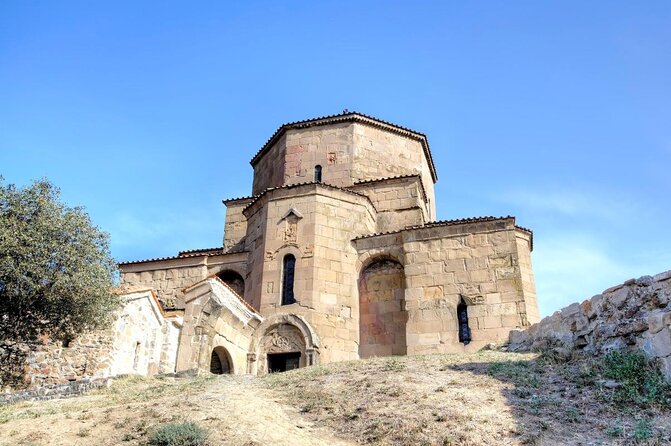
- Jvari Monastery gives you the big opening view: You look across Mtskheta toward the meeting point of the Aragvi and Mtkvari rivers.
- Svetitskhoveli is more than a quick photo stop: Mtskheta was Georgia’s early capital, and the cathedral remains a major religious site.
- Gori adds a difficult Soviet chapter: The Stalin Museum presents the leader’s birthplace, life, and armored train.
- Uplistsikhe rewards sturdy shoes: The ancient cave town has uneven rock surfaces and exposed paths.
- The tour is private: Only your group participates, with a driver-guide and hotel pickup and drop-off.
- Budget for 30 GEL in listed entrance fees: The Stalin Museum and Uplistsikhe each cost 15 GEL per person, while the first two stops are free.
Why this seven-hour route works from Tbilisi
This is a strong choice if you want to get beyond Tbilisi without committing to a long multi-day journey. The route links four sites that feel very different from one another, so the day does not become a string of similar churches or ruins.
You begin at 10:00 am and return to the meeting point in Tbilisi. The listed visits add up to roughly three and a half hours, leaving the rest of the day for driving between sites. That makes the schedule efficient, but it also means you should expect a purposeful outing rather than a slow day with long meals and free time.
The private format matters here. You are not joining a large group, and only your own party takes part. A private car also makes hotel pickup and drop-off easy. Guides named in past feedback include Irakli and Davit, both praised for good communication and strong storytelling. Your assigned guide may differ, but the format gives you a direct person to ask about Georgia’s religious, royal, and Soviet past.
The tour costs $100 per person. That is a fairer value for a small party than for one person, since the vehicle and guide serve your group alone. Add the 30 GEL per-person total for the two listed admissions, plus food and drinks. If you are traveling alone, the price is less attractive than it is for two or more people sharing the private experience.
More mtskheta & jvari tours in Tbilisi:
- Day Trip to Mtskheta Gori and Uplistsikhe
★ 5.0 · 1,801 reviews - Tbilisi:Mtskheta,Jvari,Bazaar,wine tasting,Chronicles of Georgia
★ 5.0 · 730 reviews - Mtskheta-Gori-Uplistsikhe
★ 5.0 · 112 reviews
Jvari Monastery and the meeting of two rivers
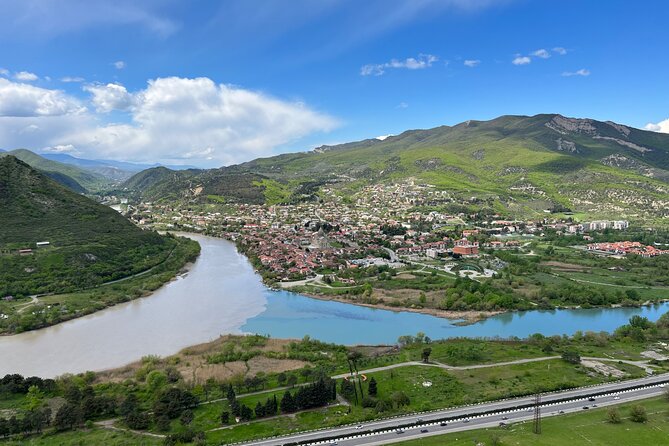
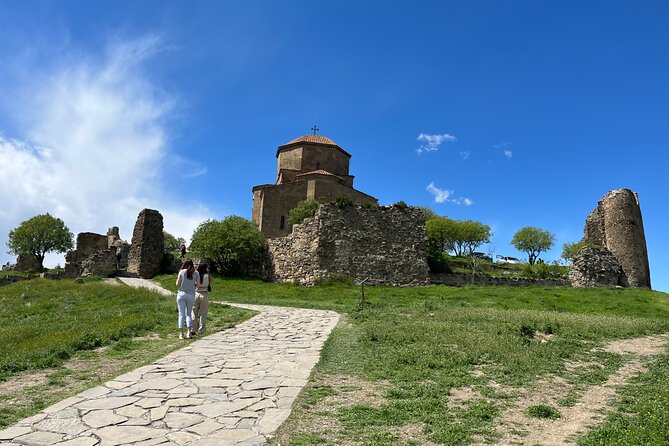
Jvari Monastery is a brief stop, listed at about 30 minutes, but it gives the day its best wide view. The sixth-century Georgian Orthodox monastery sits on a hill above Mtskheta, with the Aragvi and Mtkvari rivers meeting below.
This is the place to get your bearings. From the hill, you can see why Mtskheta became such an important center. The old capital lies below, while the rivers and surrounding countryside explain the site’s strategic value better than a paragraph of history could.
The church itself is compact compared with the larger cathedral that follows. Your time here is mainly about the setting, the view, and the sense of Georgia’s early Christian tradition. Admission is free, so this stop adds real value without increasing the ticket budget.
Thirty minutes is enough for the planned visit, especially if your main goal is the panorama. If you like architectural detail or want quiet time inside, the schedule may feel short. Still, Jvari is a smart first stop because it places the next destination, Mtskheta, in its geographic and historic setting.
Mtskheta and the meaning of Svetitskhoveli
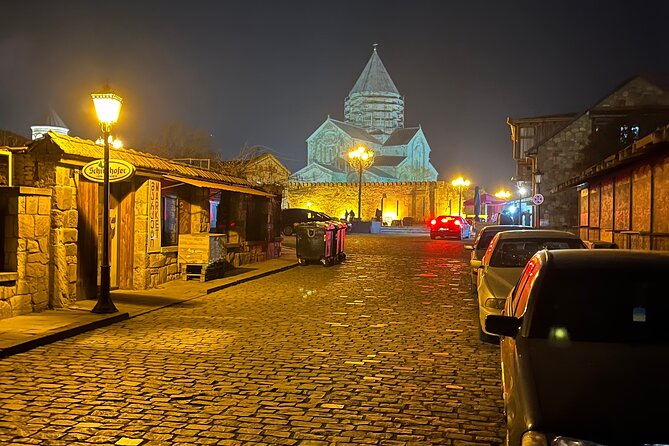
Mtskheta was founded in the fifth century BC and served as the capital of the early Georgian Kingdom of Iberia from the third century BC to the fifth century AD. Political power later moved to Tbilisi, but Mtskheta kept its role as a coronation and burial place for many Georgian kings.
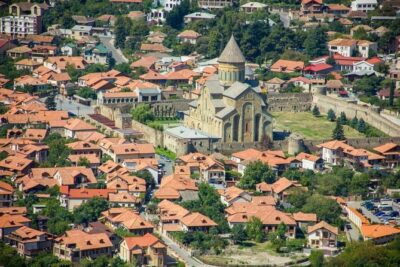
The town’s central draw is Svetitskhoveli Cathedral, an Early Medieval masterpiece and a UNESCO World Heritage site. The visit lasts about one hour and admission is free. That combination makes this one of the tour’s best uses of time.
Inside, you encounter a living place of worship, not simply an old monument. The cathedral is tied to the belief that Christ’s robe lies beneath it, a tradition that gives the building added religious importance. Your guide can help connect that belief with Georgia’s Christian identity and the long role of Mtskheta in national history.
Dress and behave respectfully at this active religious site. The information provided does not list a formal dress code, but a modest approach is sensible for an Orthodox cathedral. You should also remember that service activity or local conditions can affect how much of the interior you can study.
I would give Mtskheta careful attention rather than treating it as a quick stop between Jvari and Gori. Jvari gives you the view, but Svetitskhoveli gives you the historical weight of the old capital. Together, the two stops form the clearest picture of Georgia’s early religious and political center.
Gori and the complicated story of Stalin
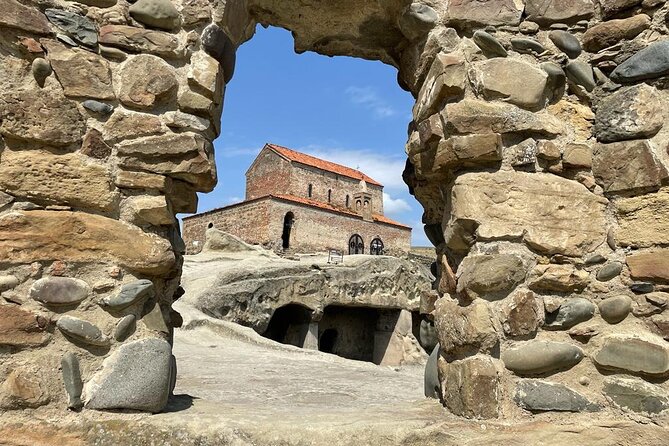
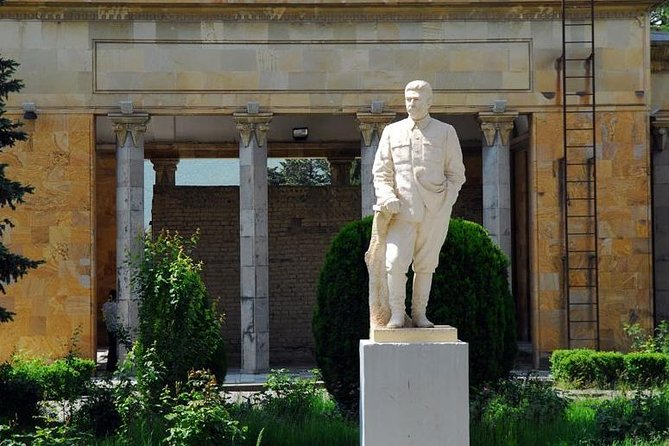
The road then continues to Gori, the birthplace of Joseph Stalin. The Stalin Museum occupies the house where he was born and grew up, and the visit lasts about one hour. You can also see his armored train.
This stop changes the tone of the day. Jvari and Mtskheta focus on faith, medieval Georgia, and national tradition. Gori turns to the Soviet period and one of the twentieth century’s most powerful and controversial political figures.
The museum can be useful if you want to understand how Stalin is presented in his birthplace. It is not simply another old building to admire. You are looking at a site connected to a leader whose rule affected millions of people, so the visit deserves a thoughtful and critical eye.
The entrance ticket is not included. The listed price is 15 GEL per person. Bring this cost into your planning, along with the 15 GEL fee for Uplistsikhe. The tour description does not say that lunch or museum tickets are covered by the $100 price, so assume they are separate.
An hour is enough for the planned museum visit, but the experience will depend on how much time you spend with the exhibits and the guide’s explanation. Past feedback specifically praises guides Irakli and Davit for explaining the sites and keeping communication pleasant. That matters most at Gori, where context helps you make sense of what you are seeing.
You may also find this stop less comfortable than the churches or ruins. That is not a reason to skip it. It is a reason to approach it as a serious historical stop rather than a simple celebrity birthplace.
More gori & uplistsikhe tours in Tbilisi:
- Mtskheta, Jvari, gori, uflistsikhe, history and panorama (group tours)
★ 4.5 · 107 reviews - Day tour to Chronicles of Georgia, Gori city, Uplistsikhe cave
★ 5.0 · 86 reviews - Ancient Georgia Group Tour: Mtskheta,Jvari, Gori, Uplistsikhe
★ 4.5 · 73 reviews - Mtskheta – Jvari + Gori – Uplistsikhe Tour
★ 5.0 · 49 reviews
Uplistsikhe, a town carved into rock
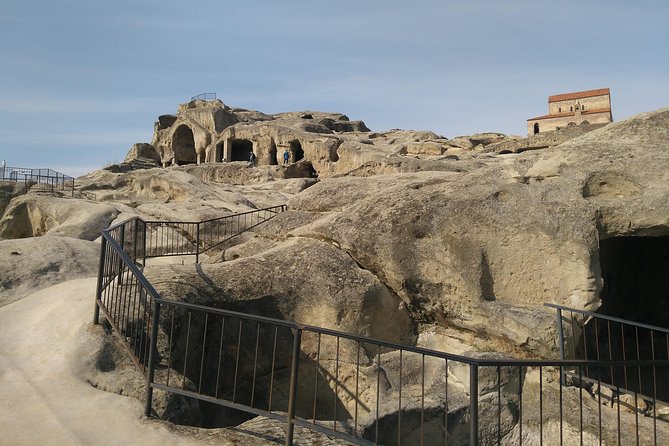
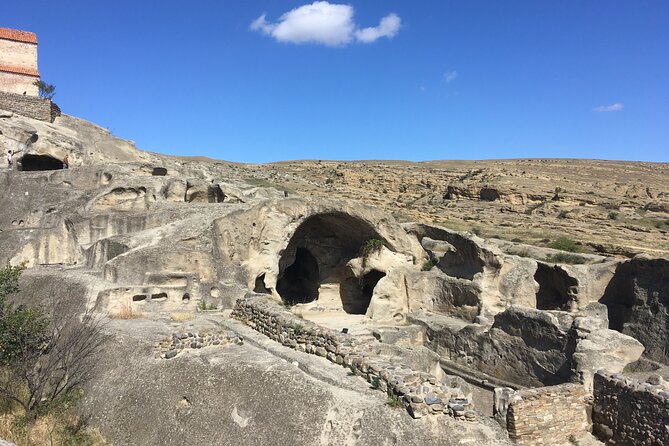
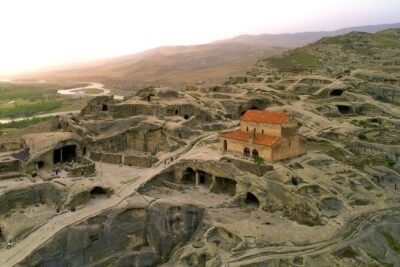
Uplistsikhe means Fortress of the Lord. This ancient cave town was carved from rock beside the old Silk Road and served as a strategic and commercial center. At its height, the city had a population of about 20,000.
The site is the tour’s most unusual architectural stop. Instead of entering a single monument, you move through an entire rock-hewn complex. The spaces show how a settlement could use the stone itself for rooms, passageways, and public areas.
Uplistsikhe has a powerful sense of place because it sits directly on an old trade route. Its value is not only the age of the site. It is the way the ruins explain movement, trade, defense, and settlement in a region that connected larger parts of the ancient world.
The planned visit lasts about one hour, and admission costs 15 GEL per person. The information provided does not describe the exact walking surface or accessibility, but a cave town cut into rock naturally calls for care on uneven ground. Choose practical footwear and watch your step.
This is also the stop where weather can affect your comfort most. Much of the interest comes from moving among open rock spaces and exposed paths, so carry what you need for the conditions on the day. Do not expect a polished museum experience. Uplistsikhe is about the remains of a place shaped by stone, time, and use.
With only an hour, focus on the overall layout and the most distinctive carved spaces. Your guide can help you see the site as a former town rather than a collection of empty chambers.
What the private format adds
The private setup is one of the tour’s strongest practical features. Your group receives a private vehicle, driver-guide, and hotel pickup and drop-off. You do not need to arrange separate transport to Jvari, Gori, or Uplistsikhe.
A private tour does not automatically mean a completely open schedule. The day still includes four stops and has an approximate seven-hour duration. But you avoid waiting for a large group to board, gather, or finish every photo. That makes the route more comfortable for couples, families, and small groups with shared interests.
The guide is especially important because the route crosses several periods of Georgian history. You move from sixth-century Orthodox architecture to an ancient capital, then to Soviet memory and an ancient rock town. Good explanations can turn those stops into one connected story.
Past feedback names Irakli and Davit as guides who made the day pleasant and explained more than the basic sights. One account also highlights flexibility when plans changed. That suggests the provider can respond sensibly to changes, though you should not assume every request can be accommodated or that every guide will be the same.
Price, tickets, and what you need to budget
At $100 per person, the tour includes the main transport and service elements that can otherwise be awkward to arrange from Tbilisi:
- Private vehicle
- Driver-guide
- Hotel pickup and drop-off
- Fuel surcharge
Jvari and Svetitskhoveli have no admission charge according to the tour details. The Stalin Museum costs 15 GEL per person, and Uplistsikhe costs another 15 GEL per person. Food, drinks, and lunch are not included.
For two people, the private format can be a reasonable way to cover four major places in one day. For a larger private group, the per-person price may feel better still, assuming the same total tour price structure applies at booking. Group discounts are listed as a feature, so check the exact rate for your party before paying.
The value comes from convenience and coverage, not from included extras. You are paying for a dedicated vehicle, a guide, and a route that would be difficult to manage comfortably with public transportation in a single day. If you prefer long meals, independent wandering, or a slow look at one site, a shorter and more focused outing may suit you better.
Who should book this day trip
I would recommend this tour to you if you are staying in Tbilisi and want a broad introduction to central Georgian history in one day. It suits first-time visitors who want ancient churches, an old capital, Soviet-era history, and archaeology without changing hotels.
It is also a good fit for couples, families, friends, and small groups that value a private car. People with a strong interest in religious buildings will appreciate Jvari and Svetitskhoveli. History-minded visitors will find Gori and Uplistsikhe add needed variety.
You should think twice if your priority is a relaxed schedule. The tour covers a lot of ground, and the listed visits are tightly timed. It may also be less suitable if uneven stone surfaces are difficult for you, since Uplistsikhe is a rock-hewn site and no specific accessibility information is provided.
Confirmation is received at booking, the tour begins at 10:00 am, and it ends back at the meeting point in Tbilisi. Free cancellation is available if you cancel at least 24 hours before the start time. Cancellations or changes made less than 24 hours ahead are not accepted for a refund.
Should you book Sacred Sites and Ancient Wonders?
Book it if you want a well-packed private day that shows several sides of Georgia. Jvari and Mtskheta provide the spiritual core, while Gori and Uplistsikhe prevent the tour from becoming a church-only outing.
The strongest reasons to choose it are the private transport, hotel service, free admission at the first two sites, and the range of history covered. The main cautions are the extra ticket costs, no included lunch, and the brisk pace.
For a small group sharing the $100-per-person cost, this is a practical way to reach four major sites from Tbilisi. For a solo visitor, compare the price carefully. If you accept the long day and plan for the two paid entries, the route offers a lot of substance in a compact format.
FAQ
Where does the tour begin?
The tour begins in Tbilisi, Georgia, with a start time of 10:00 am.
Where does the tour end?
The activity ends back at the meeting point in Tbilisi.
How long does the tour last?
The tour lasts approximately seven hours.
Is this a private tour?
Yes. Only your group participates in the activity.
Is hotel pickup included?
Yes. Hotel pickup and hotel drop-off are included.
What transportation is provided?
A private vehicle is provided, along with a driver-guide.
Are entrance fees included?
No. Jvari Monastery and Svetitskhoveli Cathedral have free admission listed. The Stalin Museum and Uplistsikhe each cost 15 GEL per person.
Is lunch included?
No. Food, drinks, and lunch are not included.
Can I cancel for a full refund?
Yes, if you cancel at least 24 hours before the experience start time. Cancellations made less than 24 hours before the start time are not refunded.
Just added around Tbilisi
- Private Adorable City Tour of Tbilisi★ 5.0 · 3 reviews
- Old tbilisi walking tour & wine tasting★ 5.0 · 9 reviews
- Tbilisi Airport to Gudauri, Bakuriani, Batumi, Tbilisi★ 5.0 · 3 reviews
- Your unique photo session in Tblisi, Georgia★ 3.5 · 4 reviews
- full day Kazbegi-Gudauri-jvari -from Tbilisi★ 5.0 · 6 reviews
- Vardzia. Lake Paravani, Khertvisi & Lomisa castle, Rabati★ 4.5 · 12 reviews
- Wine promenade in hospitable Tbilisi★ 5.0 · 17 reviews
- Wine Tasting Tour in Georgia’s Cradle of Wine★ 5.0 · 12 reviews
Mtskheta & Jvari Tours, compared.

Mtskheta,Jvari,Bazaar,wine tasting,Chronicles of Georgia
Read our review →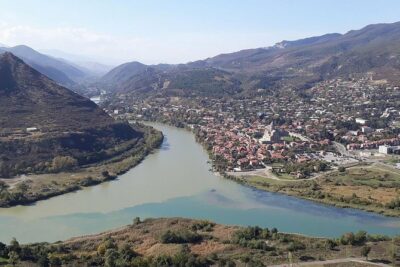
Mtskheta, Jvari, gori, uflistsikhe, history and panorama (group tours)
Read our review →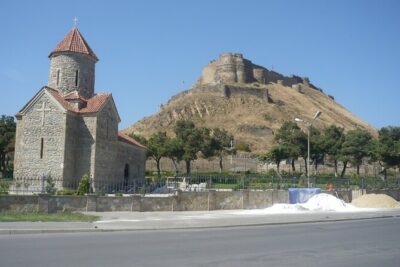
Ancient Georgia Group Tour: Mtskheta,Jvari, Gori, Uplistsikhe
Read our review →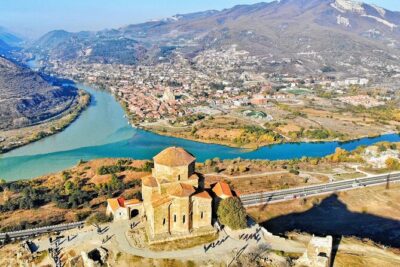
Ancient Mtskheta and Chronicle of Georgia half day tour
Read our review →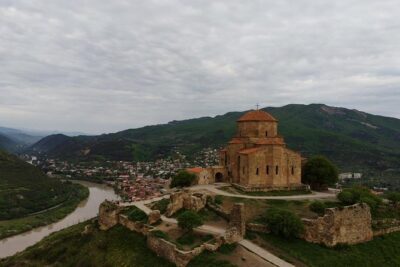
Private Day Trip to Gudauri and Kazbegi from Tbilisi via Jvari and Mtskheta
Read our review →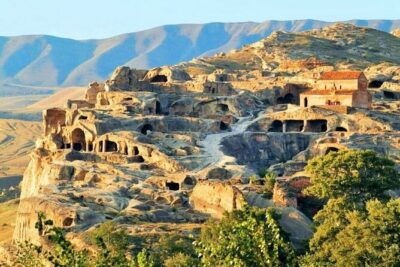
Browse the lists this tour appears in