

Reviewed · WINE TOURS
Very Friendly Tbilisi Walking Tour (wine tasting & cable car)
Tbilisi’s best sights are packed into a walkable old center, and this four-hour tour links them in a sensible route rather than leaving you to piece the city together on your own. You’ll see ancient churches, a Persian-style bath district, the Peace Bridge, Narikala Fortress, and the famous Mother of Georgia statue, with a cable-car ride adding a welcome break from the hills.
I like the mix of major landmarks and small details, especially the 11th-century wall ruins, Rezo Gabriadze’s whimsical clock tower, and Leghvtakhevi Waterfall. I also like the chance to hear local context from a guide such as Anastasia de Fellini Travels, whose warm, personal style was praised in Spanish-language feedback.
The main thing to check before booking is the wine tasting. It appears in the tour name, but the stated itinerary does not identify a tasting stop, and food and drinks are excluded. Hotel pickup is also described inconsistently, so confirm those details before you pay.
In This Review
- Key points at a glance
- Why this route works well in Tbilisi
- From the old customs gate to Anchiskhati Basilica
- Erekle II Square and the modern Peace Bridge
- Metekhi Church and the city’s founding story
- The cable car to Narikala Fortress
- From the Juma Mosque to the sulfur baths
- Markets, cafés, and Sioni Cathedral
- Group size, pace, and practical comfort
- Is the $27.24 price good value?
- Who should book this Tbilisi walk?
- Should you book the Very Friendly Tbilisi Walking Tour?
- FAQ
- How long does the walking tour last?
- Where does the tour start?
- Where does the tour finish?
- Is the Tbilisi cable car included?
- Is wine tasting included?
- Is hotel pickup included?
- What is the maximum group size?
- Can I cancel for a full refund?
Key points at a glance
- Ancient Tbilisi in four hours: Cover the city’s key churches, fortifications, bridges, baths, markets, and viewpoints on foot.
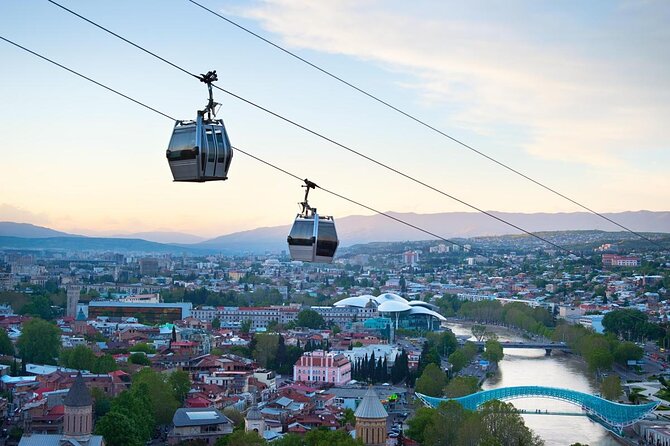
- The cable car is included: Ride from Rike Park toward Narikala Fortress, saving you a steep uphill walk.
- A personal group size is advertised: The tour description gives a maximum of 15, though another booking note lists up to 100, so confirm the group size.
- Good cultural range: The route includes Georgian Orthodox churches, a mosque, sulfur baths, old trade streets, and modern architecture.
- The guide matters here: Ask if Anastasia de Fellini Travels will lead your departure if a friendly, close-contact guiding style is important to you.
- Check two details before booking: Wine tasting and hotel pickup are not clearly included in the practical information.
Why this route works well in Tbilisi
Tbilisi is not a city best understood from a sightseeing bus. Its character comes from changes in scale and mood: a narrow lane opens onto a church courtyard, a ruined wall appears beside a modern café, and a hot-spring district sits below a medieval fortress.
This walking tour makes good use of that compact core. It begins at Pushkin Square and ends near Orbeliani Bazaar, crossing the old center rather than returning you to the starting point. That matters if you plan to continue exploring, shop for food, or find dinner after the tour.
The route is fairly full. Most stops last 10 to 15 minutes, with longer pauses at Narikala Fortress, Abanotubani, and Meidan Bazaar. You should expect a guided overview rather than long interior visits or extended free time.
At $27.24 per person, the price is reasonable if you want orientation, historical explanation, and the included cable-car ride in one half-day outing. The value is strongest on a first visit, when the city’s streets and viewpoints can otherwise feel confusing. You are paying less for admission tickets, since most stops are free, and more for the route planning and local interpretation.
A few more Tbilisi trips to weigh up
- Day Trip to Kakheti Wine Region Including 9 Wine Tastings
★ 5.0 · 2,774 reviews - Kakheti Wine Region: Signagi and Bodbe Tour with 10 Wine Tastings
★ 5.0 · 1,019 reviews - Tbilisi:Mtskheta,Jvari,Bazaar,wine tasting,Chronicles of Georgia
★ 5.0 · 730 reviews
From the old customs gate to Anchiskhati Basilica
The opening stop at the Tbilisi wall ruins gives you a quick look at the city’s defensive past. The remains and underground heritage date to the 11th century and are connected with an old customs gate. It is a short stop, but a useful one: Tbilisi was not simply a pretty collection of old houses. It was a fortified trading city positioned between larger powers.
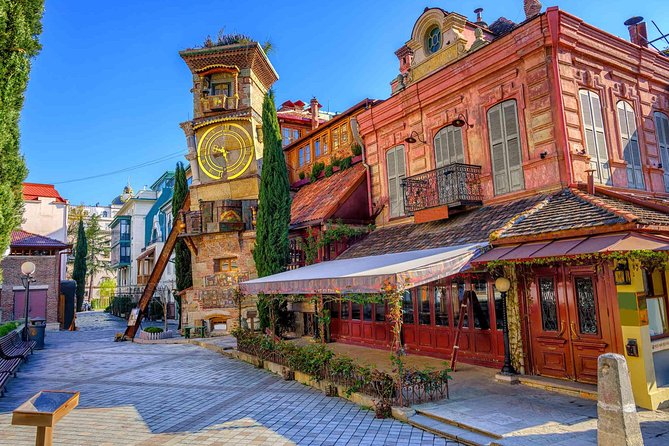
A few minutes later, the route reaches Rezo Gabriadze Marionette Theater on Shavteli Street. The theater was founded in 1981 by Georgian artist Rezo Gabriadze, and its small clock tower has become one of Tbilisi’s most recognizable sights.
The tower is playful rather than grand. Once an hour, a golden angel emerges from a painted doorway and rings a bell with a small hammer. If the timing works, this can be one of the tour’s most memorable brief moments. Do not expect a theater performance, though. The scheduled stop is about 15 minutes and admission is free.
Anchiskhati Basilica follows, with only about 10 minutes planned. Dating to the sixth century, it is the oldest church building in Tbilisi. Its name refers to the Anchi icon, which was brought here from Anchi Monastery in 1664. The original icon is now held in the Georgian National Museum.
This is a place where a guide can add real value. Georgian churches may look modest from the outside, and the short stop will not allow time for a full architectural study. A clear explanation of the church’s age, name, and place in Georgian religious life helps you understand why this small basilica matters.
Erekle II Square and the modern Peace Bridge

The route then passes the Patriarchate of Georgia near Erekle II Square. The building occupies the site of a former palace associated with King Rostom. The present structure began in 1809 on the palace ruins and later housed the Russian Orthodox Church’s exarch and offices.
This stop is brief, so treat it as a visual and historical waypoint rather than a museum visit. You will hear how Tbilisi’s religious and political buildings changed hands as outside powers shaped the city.
The Peace Bridge provides a sharp contrast. Opened in 2010, this glass-and-steel pedestrian bridge crosses the Mtkvari River between Erekle II Street and Rike. It connects the old city with Rike Park and has become a symbol of modern Tbilisi.
Some visitors like the bridge’s bold design, while others find it at odds with the old neighborhood around it. That contrast is part of the point. Tbilisi is not preserved as a single period. Its older churches, bathhouses, Soviet-era traces, and recent architecture share the same small center.
Rike Park is a pleasant pause beside the river. Its paths and planted areas are arranged to suggest a map of Georgia when viewed from above. The tour allows about 15 minutes here, enough to take in the setting and prepare for the cable car.
Metekhi Church and the city’s founding story

Across the river, Metekhi Cathedral sits on a prominent part of Old Tbilisi. The Church of the Nativity of the Virgin Mary is linked with the ancient Metekhi district and contains the tomb of Saint Shushanik.
The site also connects with Queen Tamar, one of Georgia’s most important medieval rulers. The stated tradition says she honored Saint Shushanik’s body with gilded clothing. Your visit is short, but the stop gives the guide a chance to connect the city’s religious sites with Georgia’s royal past.
Nearby, the monument to King Vakhtang Gorgasali helps explain the city’s origin story. Vakhtang I Gorgasali ruled Iberia, the Georgian kingdom also known as Kartli, during the late fifth and early sixth centuries. He is closely associated with the founding of Tbilisi.
The statue stop lasts only about five minutes. That is enough for a quick explanation and a photograph, but not enough for a long discussion of the king’s difficult wars with Sasanian Iran. If ancient Georgian history interests you, this is a good point to ask your guide for the short version and note the names for later reading.
Same mountains, a completely different kind of day:
- Highlights of Caucasus Mountains-Jinvali,Ananuri,Gudauri,Kazbegi(Group tour)
★ 5.0 · 2,682 reviews - Day Trip to Kazbegi and Gudauri
★ 5.0 · 2,009 reviews - Day Trip to Mtskheta Gori and Uplistsikhe
★ 5.0 · 1,801 reviews - Tbilisi Walking Tour Including Cable Car and Traditional Bakery
★ 5.0 · 1,310 reviews
The cable car to Narikala Fortress
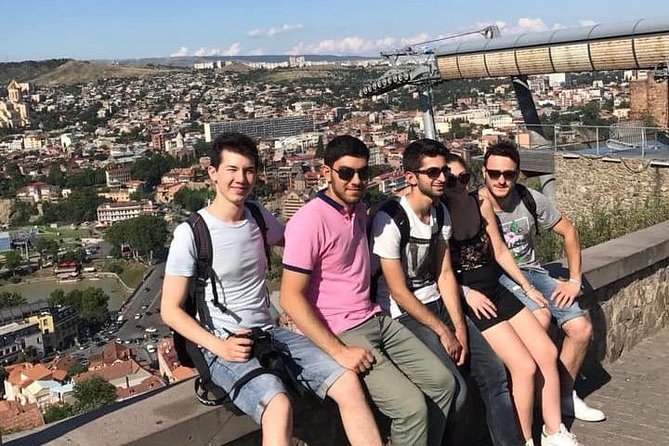
The Tbilisi Aerial Tramway runs from Rike Park to the Narikala Fortress area. The ride is included, which improves the tour’s value and saves you from making the full climb on foot.
The cable car also changes your view of the city. From above, the Mtkvari River, tiled roofs, churches, bridges, and hills fit together more clearly than they do at street level. The ride itself is short, listed at about 10 minutes, but it creates one of the tour’s best transitions.
At the top, you’ll see Kartlis Deda, the Mother of Kartli statue. The figure holds a wine glass in one hand for friends and a sword in the other for enemies. It is a simple image with a useful message about Georgian identity: hospitality is generous, but national pride is not soft.
Narikala Fortress occupies the slope of Mtatsminda and dates back to the fourth century, around the early life of Tbilisi itself. Arabs expanded the fortifications in the seventh and eighth centuries, giving parts of the present site an unmistakable Middle Eastern defensive character. The grounds also include a 12th-century Saint Nicholas Church.
The scheduled fortress visit lasts about 20 minutes. Wear shoes you trust on uneven ground, and take care near exposed edges. The tour data does not promise an extended fortress walk or a long viewpoint stop, so think of this as a concise introduction rather than a full archaeological visit.
From the Juma Mosque to the sulfur baths
The descent from Narikala leads toward the Tbilisi Mosque, also called the Juma Mosque. It is currently the city’s only Muslim shrine. The first Sunni mosque on this site was built by the Ottomans between 1723 and 1735, destroyed by the Persians in the 1740s, and rebuilt in the 19th century.
The mosque adds an important layer to the tour. Tbilisi’s identity is not only Georgian Orthodox. The route presents churches, a mosque, old trade streets, and bathhouses within a compact area, helping you see the city as a meeting point of cultures.
Next comes Leghvtakhevi Waterfall, a 22-meter fall tucked into the old city. The name comes from the Georgian word for fig, since fig trees once grew around the gorge. The waterfall is a refreshing change from monuments and formal squares, and the 10-minute stop gives you time for photographs.
Abanotubani, the sulfur-bath district, follows. The baths sit on the eastern bank of the Mtkvari below Narikala, where naturally hot sulfur springs shaped the neighborhood. The baths were built at different times, mainly between the 17th and 19th centuries, and the district is one of the clearest examples of Tbilisi’s name and identity being tied to hot water.
Chreli Abano is among the best-known bath buildings in the area. Its colorful exterior can look like a mosque, but it is a sulfur bath. This tour does not include a bath session, and there is no stated time for changing or bathing, so you should not expect to use the facilities during the walk.
Markets, cafés, and Sioni Cathedral

Meidan Bazaar offers a short look at Tbilisi’s commercial side. The square has long served as a trading area and was noted by French traveler Jean Chardin in the 18th century. It has carried several names over time, including Shaitan Bazaar and Tatris Moedani.
Today, it is a practical place to browse Georgian wine, handmade accessories, souvenirs, and local delicacies. The tour allows about 20 minutes, which is enough to look around but probably not enough for serious shopping. If you find a bottle or food item you want, ask about carrying it during the rest of the walk.
Jan Shardeni Street is a narrow pedestrian area lined with cafés, galleries, and shops. It joins nearby Bambis Rigi, Rkinis Rigi, and Erekle II streets as one of the old center’s main social zones.
This part of the route is more modern and commercial than the churches and fortress. I like having it included because it shows how Old Tbilisi functions today, not only how it looked centuries ago. The tradeoff is that the streets can feel more polished and tourist-oriented than the quieter lanes nearby.
The final major stop is Sioni Cathedral. The cross-domed church sits on the lower right bank of the Mtkvari and has served as a cathedral since the fifth century. It became Georgia’s patriarchal cathedral in 1920.
The planned visit is about 10 minutes. Dress respectfully for church visits, and remember that a short stop may mean viewing the exterior and main setting rather than studying every detail inside.
Group size, pace, and practical comfort

The tour is advertised as a small-group experience with a maximum of 15 people, which should make it easier to hear the guide and ask questions. However, the additional booking information gives a maximum of 100 participants. That is a meaningful difference, so confirm the actual group limit for your date.
The walk lasts about four hours and includes hills, stairs, uneven surfaces, and the descent from the Narikala area. Most able-bodied participants can take part, but the route is not a flat stroll. Children must be accompanied by an adult, and service animals are allowed.
Bottled water is included. Food and other drinks are not, and there is no clearly stated meal break. Bring water beyond the supplied bottle if you need it, and plan to eat before or after the tour.
The tour begins at Tbilisi Pushkin Square and finishes near Orbeliani Bazaar. Hotel pickup and drop-off are not included in the listed inclusions, although hotel pickup is described elsewhere as available. Confirm the arrangement rather than assuming it is part of the $27.24 price.
The tour accepts mobile tickets, confirmation is provided at booking, and it is near public transportation. Free cancellation is available up to 24 hours before the start time. A minimum number of participants is required, and if that minimum is not met, you are offered another date or a full refund.
Is the $27.24 price good value?
For a first day in Tbilisi, yes, with a few qualifications. The tour covers a great deal of ground, includes the cable car, and gives you a usable map of the Old Town. You also finish near Orbeliani Bazaar, a handy place to continue your day.
The price is less compelling if you already know Tbilisi well or prefer to spend 30 minutes inside each church and fortress. The itinerary moves quickly, and most stops are short. You are buying a guided introduction, not a specialist architecture tour.
The unclear wine tasting is the biggest value question. Since the experience title includes wine tasting but the practical details exclude food and drinks, ask exactly what is provided. If there is no tasting, the tour should be judged as a walking tour with a cable-car ride, not as a wine experience.
Who should book this Tbilisi walk?
I would choose this tour for a first visit, especially if you want to understand the Old Town before exploring it independently. It suits people who enjoy a steady route, short historical explanations, viewpoints, and a blend of religious, architectural, and everyday sights.
It is also a good fit if you want a friendly guide. Anastasia de Fellini Travels is associated with especially warm feedback, including a personal Spanish-language exchange, so you can ask whether she is leading your date.
I would hesitate if you need a fully flat route, a long lunch stop, guaranteed wine tasting, or extensive time inside every monument. In that case, confirm the details first or choose a slower private tour.
Should you book the Very Friendly Tbilisi Walking Tour?
Book it if you want a well-packed introduction to Tbilisi, value a local guide, and like the idea of combining the Old Town with Narikala and the cable car. The route gives you the city’s big picture without requiring separate planning for each landmark.
Before booking, confirm three points: the actual group size, whether hotel pickup is available for your address, and what the wine tasting includes. With those details settled, $27.24 is a fair price for four hours of orientation, local context, and one of Tbilisi’s most useful scenic rides.
FAQ
How long does the walking tour last?
The tour lasts approximately four hours.
Where does the tour start?
It starts at Tbilisi Pushkin Square in Tbilisi, Georgia.
Where does the tour finish?
The tour ends at Orbeliani Square, near Orbeliani Bazaar.
Is the Tbilisi cable car included?
Yes. The aerial tramway from Rike Park toward Narikala Fortress is listed as included.
Is wine tasting included?
The experience title mentions wine tasting, but the provided tour details do not identify a tasting stop. Food and drinks are listed as excluded, so confirm this before booking.
Is hotel pickup included?
Hotel pickup and drop-off are listed as not included. Another description says hassle-free hotel pickup is available, so you should confirm the arrangement with the provider.
What is the maximum group size?
The tour highlights state a maximum of 15 people for a small-group experience. Additional booking information lists a maximum of 100 travelers, so confirm the group size for your selected date.
Can I cancel for a full refund?
Yes. You can cancel at least 24 hours before the experience start time for a full refund. Changes or cancellations made less than 24 hours before the start time are not accepted for a refund.
More Walking Tours in Tbilisi
- Tbilisi:Evening Walking & Talking Tour with Wine & Boat Ride
★ 5.0 · 572 reviews - Old Tbilisi Highlights walking tour with wine & 10 tastings
★ 5.0 · 276 reviews - Old Tbilisi Tour: Private Walking Tour With Wine Tasting
★ 5.0 · 273 reviews - Private Tbilisi Food Tour: 9 Tastings Walk in Bohemian District
★ 5.0 · 227 reviews
Just added around Tbilisi
- Private Adorable City Tour of Tbilisi★ 5.0 · 3 reviews
- Old tbilisi walking tour & wine tasting★ 5.0 · 9 reviews
- Tbilisi Airport to Gudauri, Bakuriani, Batumi, Tbilisi★ 5.0 · 3 reviews
- Your unique photo session in Tblisi, Georgia★ 3.5 · 4 reviews
- full day Kazbegi-Gudauri-jvari -from Tbilisi★ 5.0 · 6 reviews
- Wine promenade in hospitable Tbilisi★ 5.0 · 17 reviews
- Vardzia. Lake Paravani, Khertvisi & Lomisa castle, Rabati★ 4.5 · 12 reviews
- Wine Tasting Tour in Georgia’s Cradle of Wine★ 5.0 · 12 reviews
Wine Tours, compared.
Day Trip to Kakheti Wine Region Including 9 Wine Tastings
Read our review →
Kakheti Wine Region: Signagi and Bodbe Tour with 10 Wine Tastings
Read our review →
Mtskheta,Jvari,Bazaar,wine tasting,Chronicles of Georgia
Read our review →
Evening Walking & Talking Tour with Wine & Boat Ride
Read our review →
City of Love Sighnaghi, Bodbe. KTW. Wine House Group tour
Read our review →
Bodbe, Sighnaghi, Telavi Wine Tour from Tbilisi
Read our review →
Old Tbilisi Highlights walking tour with wine & 10 tastings
Read our review →
Old Tbilisi Tour: Private Walking Tour With Wine Tasting
Read our review →Browse the lists this tour appears in