Reviewed · TOURS
Soviet Tour – Hidden Tbilisi
Tbilisi’s Soviet past is easiest to grasp away from the postcard streets. This small-group tour takes you to a daring bank headquarters, the huge Chronicles of Georgia monument, and a secret underground printing house tied to Stalin’s early revolutionary work.
I like the maximum of six people, which gives you room to ask questions, and I like the air-conditioned vehicle because these sights are spread across Tbilisi. Guides including Giorgi, Irakli, and David are praised for clear history and architectural stories. The main drawback is simple: $99 is a serious price for a 3 to 4-hour tour, and you must reach the meeting point yourself.
In This Review
- Key points to know before booking
- Why Soviet Tbilisi deserves a separate tour
- A small vehicle makes the wide route practical
- The two-hour opening route through lesser-seen Tbilisi
- Bank of Georgia headquarters: practical design on a giant scale
- Chronicles of Georgia and its broad city view
- Stalin’s underground printing house brings the politics close
- The guides shape the experience
- Is $99 a fair price?
- Who should book this experience?
- Practical points before you go
- Should you book Soviet Tour, Hidden Tbilisi?
- FAQ
- How long does the Soviet Tour, Hidden Tbilisi last?
- Where does the tour start?
- Where does the tour finish?
- Is transportation included?
- How many people can join?
- Is the tour offered in English?
- What is included in the price?
- Is admission included at every stop?
- Does the tour visit the Chronicles of Georgia?
- Can I cancel for a full refund?
Key points to know before booking
- The Bank of Georgia headquarters is a top example of Soviet architecture, with a shape designed for practical reasons rather than decoration.
- The Chronicles of Georgia pairs Socialist monumentalism with wide views over Tbilisi’s outer districts.
- Stalin’s underground printing house adds a human and political side to the tour, not just large concrete buildings.
- A group of no more than six makes this feel closer to a guided outing than a coach excursion.
- The guides add personal context, including stories about daily life, censorship, architecture, and Georgia under Soviet rule.
- An optional Soviet car museum stop may be possible, but it is not part of the core route and should be confirmed before you count on it.
Why Soviet Tbilisi deserves a separate tour
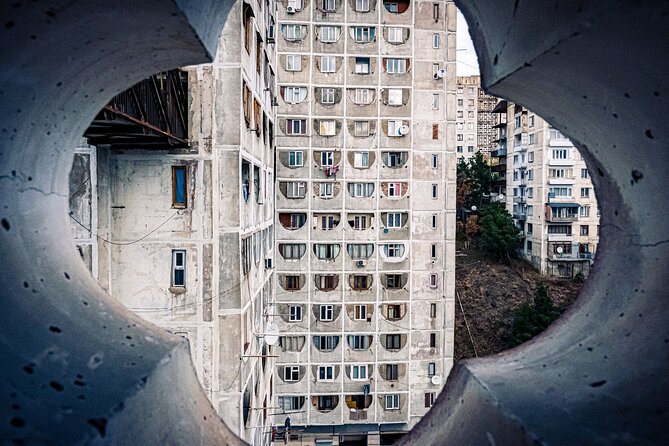
Tbilisi is often sold through its old town, sulfur baths, churches, balconies, and hillside views. Those are worthwhile, but they tell only part of the city’s story. Soviet Tbilisi is less polished and often more surprising. It appears in monumental concrete, grand public buildings, working-class districts, and places built for secrecy.
This experience is designed to connect those pieces. Instead of asking you to admire a building and move on, the guide explains how Soviet ideas shaped its use, scale, and appearance. That matters in Georgia, where the Soviet period is close enough to living memory to remain personal and political.
The tour is not only about architecture. You also learn how the period affected ordinary life, public messaging, censorship, and national identity. One guide even brought up small cultural details such as cartoon characters being banned in some communist countries. Details like that can make a large political system easier to understand.
The route moves around the city, so you are not left trying to connect far-flung sights by bus or taxi. You see unusual places that would be hard to combine on your own in a short afternoon.
Other Tbilisi days people book alongside this one:
- Day Trip to Kakheti Wine Region Including 9 Wine Tastings
★ 5.0 · 2,774 reviews - Highlights of Caucasus Mountains-Jinvali,Ananuri,Gudauri,Kazbegi(Group tour)
★ 5.0 · 2,682 reviews - Day Trip to Kazbegi and Gudauri
★ 5.0 · 2,009 reviews
A small vehicle makes the wide route practical
The group is capped at six people, and transport is by air-conditioned vehicle. That is a useful combination in Tbilisi, where the sights are spread out and the weather can make outdoor stops tiring.
You are not paying only for a ride. The vehicle gives the guide time to explain what you are seeing between stops, while the small group leaves room for questions. Past guides such as Giorgi, Irakli, and David have been praised for their strong background in Georgian and Soviet history, as well as their ability to explain how architecture relates to modern Georgia.
The advertised duration is about 3 to 4 hours. The scheduled stops add up to roughly 3 hours and 25 minutes before driving time, so the exact finish may vary. One highly positive account describes a journey of about five hours, with five Soviet-related places and conversations with historians. That suggests the pace can stretch when the guide adds context or an extra stop.
I would not book this immediately before a flight, train, or fixed dinner reservation. The flexible format is part of the appeal, but it also means you should allow extra time.
The tour starts at 2 Rose Revolution Square and ends back there. Transport to the meeting point is not included, so plan that part separately. The meeting point is near public transport, which makes the start fairly manageable.
The two-hour opening route through lesser-seen Tbilisi
The first part lasts about two hours and introduces the non-touristic side of the city. Rather than presenting one single monument, the guide takes you between several Soviet-era buildings and sites spread across Tbilisi.
This opening section is where the guide matters most. The buildings may not explain themselves, and some can look severe or purely functional at first glance. Your guide helps you notice how Soviet planning affected scale, decoration, access, and daily use.
Expect a mix of monuments and buildings rather than a polished museum route. That is good news if you want to see how the period still fits into the working city. It also means the visual experience is uneven. Some sights may interest you mainly because of their history, while others make an immediate impression through size or unusual design.
The tour provider describes this portion as exclusive access, along with a professional local guide focused on history. The exact meaning of exclusive access is not spelled out, so I would treat the real value as the small group and the guide’s access to local knowledge rather than assume every location is privately closed to the public.
Bank of Georgia headquarters: practical design on a giant scale
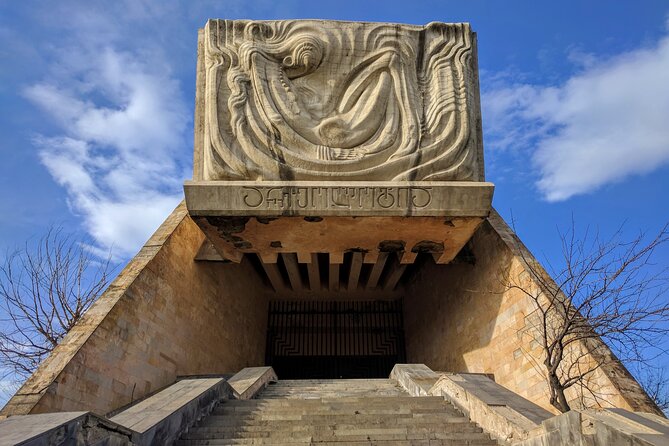
The Bank of Georgia headquarters is one of the tour’s best architecture stops. It is regularly placed among leading examples of Soviet architecture, and its odd shape gives the guide a chance to explain how practical needs can produce a bold design.
You get about 15 minutes here, with no admission fee. That is not a long visit, but it should be enough for an exterior explanation and photographs. The short stop also keeps the tour moving, since the main purpose is to understand the building’s form and function rather than spend hours inside.
This is a good example of why a guide helps. A large, unusual office building can seem like a strange object from another era. Once you hear the practical reason behind its design, it becomes easier to read as a solution to a problem, not simply an act of Soviet grandstanding.
Do not expect a long museum visit at this stop. If you care about architecture, pay attention to the relationship between the building’s shape and its intended use. If you are mainly interested in political history, the next two stops will likely offer more direct human stories.
Same mountains, a completely different kind of day:
- Day Trip to Mtskheta Gori and Uplistsikhe
★ 5.0 · 1,801 reviews - Tbilisi Walking Tour Including Cable Car and Traditional Bakery
★ 5.0 · 1,310 reviews - Day Trip to Armenia Including Homemade Lunch
★ 5.0 · 1,162 reviews - Kakheti Wine Region: Signagi and Bodbe Tour with 10 Wine Tastings
★ 5.0 · 1,019 reviews
Chronicles of Georgia and its broad city view
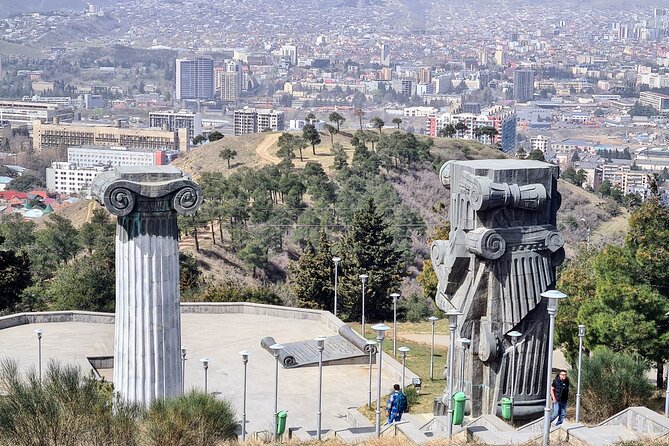
The Chronicles of Georgia is often called the Stonehenge of Tbilisi. The comparison refers to its scale and arrangement, not to any ancient origin. This is a Socialist monumental work, built to communicate history and national meaning through huge stone forms.
You have about 30 minutes here, and admission is free. The monument also offers a panorama over Tbilisi’s suburban districts, giving the stop value beyond the structure itself. Bring your camera, but give the guide time to explain what the monument was meant to express.
The site can feel removed from the familiar center of Tbilisi. That distance is useful. It lets you see how public monuments were placed to command attention and shape a civic story. The scale is impressive, but the meaning can be harder to read without help.
This is also one of the more outdoor-focused sections. Comfortable shoes and protection from strong sun or changing weather make sense, although the tour information does not specify facilities or shade. The stop is free, but it is still valuable because the vehicle and guide make it much easier to combine with the other sites.
Stalin’s underground printing house brings the politics close
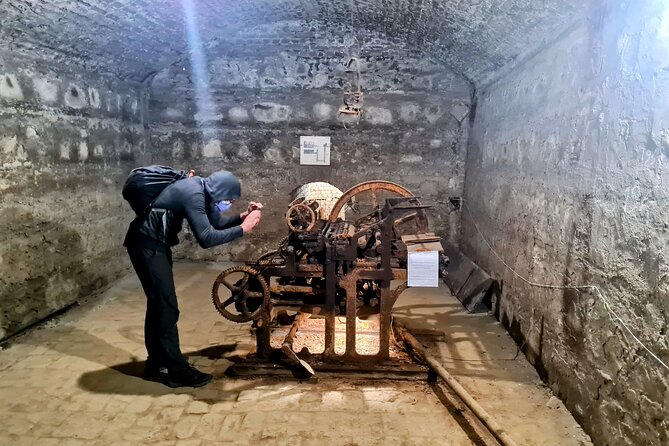
The underground printing house is the most unusual stop on the route. The museum occupies a hidden press associated with Stalin and his supporters, who used it to produce plans and propaganda leaflets.
The visit lasts about 40 minutes and admission is included. That makes it the clearest indoor museum component of the tour. Instead of looking at a monumental public building, you enter a place linked to underground organization and political messaging.
This stop gives the Soviet story a different scale. The Bank of Georgia headquarters and Chronicles of Georgia show power expressed through architecture and public space. The printing house shows how political movements worked through secrecy, written material, and organized support.
The site may appeal most to people interested in revolutionary history, censorship, and the mechanics of propaganda. It may be less comfortable for anyone hoping for a light sightseeing outing, since the subject is political and the location is tied to conflict and repression.
The strongest version of this visit includes local voices. A guide has introduced participants to historians connected with the places, allowing the past to be discussed through personal views rather than only dates and labels. That is a valuable bonus when available, but it should not be treated as a guaranteed feature of every departure.
The guides shape the experience
The tour is sold around Soviet history, but the guide determines how much you take away. Giorgi has been singled out for an energetic, educational route and for adding a personal touch with local historians. Irakli is described as excellent at answering questions about Georgian history and the Soviet period. David is noted for linking architecture to both historic and modern Georgia.
Those details give you a useful idea of the tour’s style. You can expect a conversation rather than a memorized list of dates. One guide even adjusted the route to look at subjects beyond the planned sights, and later dropped the group at a more convenient location for the rest of the day. That kind of flexibility can be very helpful in a small group.
The guides also add food and local warmth to the outing. One participant received a special khachapuri filled with beans at the end. It is not listed as an included feature, so do not book for the pastry, but it shows the sort of personal gesture that can make a private-feeling tour memorable.
You should ask questions. The small group makes that possible, and the subject rewards curiosity. Ask how a building was used, how Georgians remember the Soviet years, or how public imagery changed after independence.
Is $99 a fair price?
At $99 per person, this is not a budget sightseeing ride. The price includes the air-conditioned vehicle, a local guide, exclusive access as described by the provider, and entry to the underground printing house. The Bank of Georgia headquarters and Chronicles of Georgia do not charge admission.
The value comes from the route and the interpretation. You are paying to connect several far-apart sites, avoid arranging separate taxis, and hear the history explained in English. A group of up to six also gives you a more focused experience than a large bus tour.
The price is harder to justify if you only want quick photographs of Soviet buildings. You could see some public architecture independently, though arranging the full route would take more time and local planning. It is easier to justify if you have a strong interest in the Soviet Union, twentieth-century architecture, Georgian politics, or places outside the standard Tbilisi circuit.
Group discounts may be available, but the supplied details do not state the discount amount. Ask before booking if you are traveling with several people.
Who should book this experience?
I would choose this tour after seeing Tbilisi’s old town, not instead of it. The two experiences cover different parts of the city. The old town gives you historic streets and traditional architecture, while this outing explains a more recent and often overlooked chapter.
It suits you best if you:
- Want Soviet history explained in plain English
- Prefer unusual buildings and monuments to standard sightseeing
- Like asking questions during a small-group tour
- Need air-conditioned transport between scattered sites
- Have at least half a day available
- Are comfortable with political history and monuments tied to propaganda
It may not suit you if you want a relaxed food tour, a long walk through the historic center, or a fully fixed schedule. The outdoor monument stop may also be less appealing in poor weather, and the total time can run longer than the advertised estimate.
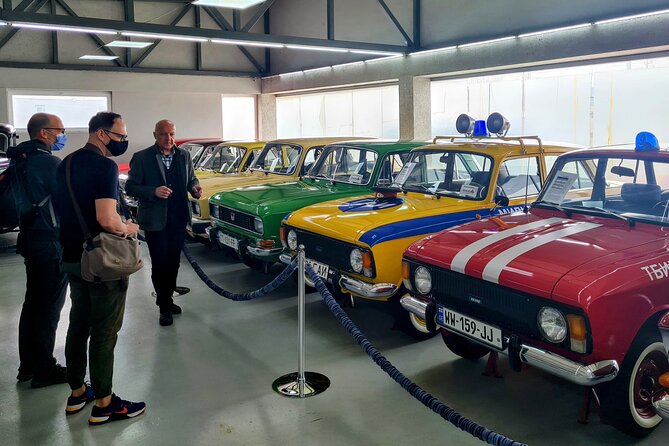
An optional Soviet car museum stop has also been added on at least one outing, with restored cars and bikes. It is not part of the core route, so ask the provider before assuming it is available or included in the price.
Practical points before you go
Confirmation arrives at booking, and the tour is offered in English. Most people can participate, and the activity is near public transportation. The supplied details do not give specific accessibility information, so contact Real Georgia Tours directly if you need step-free access or other arrangements.
The tour starts and finishes at 2 Rose Revolution Square, Tbilisi 0108. Since pickup and drop-off from your accommodation are not included, allow time to reach the square and plan your onward journey from there.
Wear shoes suitable for walking around outdoor monuments and bring what you need for sun or changing weather. The exact schedule may shift because the sites are spread across the city and the guide may spend more time answering questions.
Free cancellation is available if you cancel at least 24 hours before the local start time. Changes or cancellations made less than 24 hours ahead are not accepted for a refund.
Should you book Soviet Tour, Hidden Tbilisi?
Book it if you want Tbilisi beyond the old town and you care about the ideas behind the concrete. The Bank of Georgia headquarters, the Chronicles of Georgia, and the underground printing house give you three very different views of Soviet power: practical design, public monument, and secret political work.
The strongest reason to go is the guide-led storytelling. Giorgi, Irakli, and David have each been praised for history, architecture, clear communication, and personal attention. The small group helps you ask questions, while the vehicle makes an otherwise awkward route easy.
Skip it if $99 feels too high for a short tour, or if your main interest is medieval and traditional Georgia. For everyone else, especially visitors who want to understand how the twentieth century still shapes Tbilisi, this is a focused and worthwhile half-day outing. Allow extra time, meet at Rose Revolution Square, and go ready to look past the familiar city center.
FAQ
How long does the Soviet Tour, Hidden Tbilisi last?
The stated duration is approximately 3 to 4 hours. The scheduled stops total about 3 hours and 25 minutes before driving time, and the exact finish may vary.
Where does the tour start?
The tour starts at 2 Rose Revolution Square, Tbilisi 0108, Georgia.
Where does the tour finish?
The activity ends back at the meeting point at 2 Rose Revolution Square.
Is transportation included?
An air-conditioned vehicle is included during the tour. Transport to and from the meeting point is not included.
How many people can join?
The activity has a maximum of six participants.
Is the tour offered in English?
Yes. The tour is offered in English.
What is included in the price?
The price includes an air-conditioned vehicle, exclusive access as described by the provider, and a professional local guide. Admission to Stalin’s underground printing house is included.
Is admission included at every stop?
Admission is included at Stalin’s underground printing house. The Bank of Georgia stop and Chronicles of Georgia are listed with free admission.
Does the tour visit the Chronicles of Georgia?
Yes. The visit lasts about 30 minutes and includes time to see the Socialist monumentalism and the panorama over Tbilisi’s suburban districts.
Can I cancel for a full refund?
Yes, if you cancel at least 24 hours before the experience start time. Cancellations made less than 24 hours before the start are not refunded.
Just added around Tbilisi
- Private Adorable City Tour of Tbilisi★ 5.0 · 3 reviews
- Old tbilisi walking tour & wine tasting★ 5.0 · 9 reviews
- Tbilisi Airport to Gudauri, Bakuriani, Batumi, Tbilisi★ 5.0 · 3 reviews
- Your unique photo session in Tblisi, Georgia★ 3.5 · 4 reviews
- full day Kazbegi-Gudauri-jvari -from Tbilisi★ 5.0 · 6 reviews
- Vardzia. Lake Paravani, Khertvisi & Lomisa castle, Rabati★ 4.5 · 12 reviews
- Wine promenade in hospitable Tbilisi★ 5.0 · 17 reviews
- Wine Tasting Tour in Georgia’s Cradle of Wine★ 5.0 · 12 reviews
Tours, compared.

Highlights of Caucasus Mountains-Jinvali,Ananuri,Gudauri,Kazbegi(Group tour)
Read our review →
Tbilisi Walking Tour Including Cable Car and Traditional Bakery
Read our review →
Kakheti Wine Region: Signagi and Bodbe Tour with 10 Wine Tastings
Read our review →
Evening Walking & Talking Tour with Wine & Boat Ride
Read our review →
Kutaisi Canyons and Caves from Tbilisi Full Day Tour
Read our review →
Kazbegi and Gudauri Full Day Private Tour from Tbilisi
Read our review →
Diamond bridge and Dashbashi canyon day excursion from Tbilisi
Read our review →