Reviewed · TOURS
Soviet Tbilisi Tour – Off the beaten path
Stalin’s underground printing house is the hook here: a secret basement press hidden beneath an old private house, still presented by a devoted communist director. I like that this tour treats Soviet Tbilisi as a living part of Georgia, not just a collection of cold concrete buildings. I also like the route’s variety, from political history to grand public art and odd residential engineering.
The main consideration is that this is not a polished highlights tour of old Tbilisi. You will spend much of the day outside the usual center, looking at aging structures, Soviet housing, and unfinished monuments. That is exactly the appeal for some people, but less so if you want churches, wine bars, and postcard streets.
In This Review
- Key points at a glance
- Why Soviet Tbilisi is worth your afternoon
- Inside Stalin’s Underground Printing House
- The Chronicles of Georgia above Tbilisi Sea
- Nutsubidze’s skybridge and concrete housing
- Extra architectural stops may add context
- What the guides add to the experience
- Is $49.68 good value?
- Timing, pickup, and the practical details
- Who should book this Tbilisi tour?
- Should you book Soviet Tbilisi Tour?
- FAQ
- How long does the Soviet Tbilisi Tour last?
- How much does the tour cost?
- Is this a private tour?
- Is hotel pickup available?
- What language is the tour offered in?
- Where does the tour finish?
- Can I cancel for a full refund?
Key points at a glance
- Stalin’s hidden printing house: Enter a basement museum built around a clandestine press and Soviet-era objects.
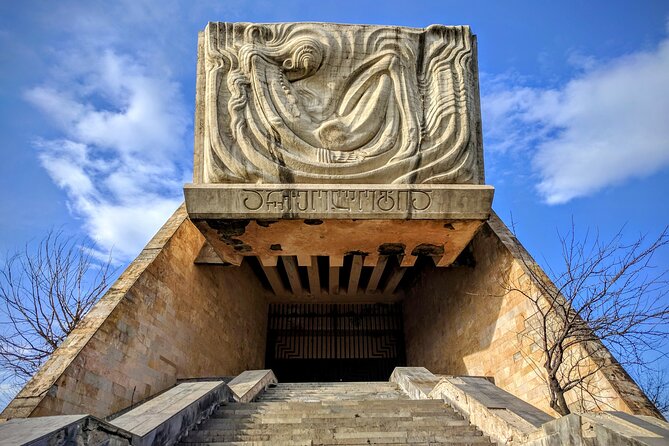
- Chronicles of Georgia: Walk around Tsereteli’s huge unfinished monument above Tbilisi Sea.
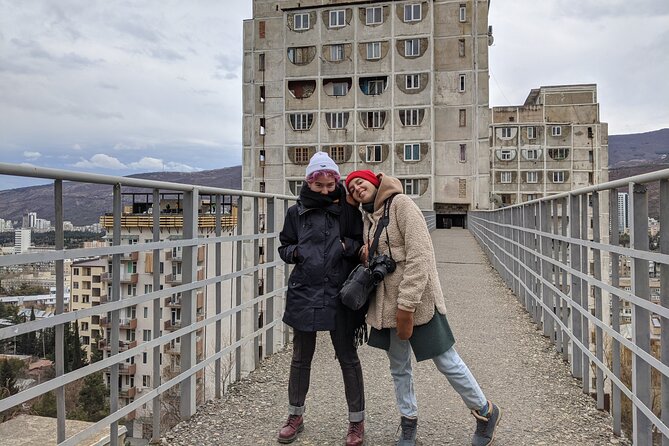
- Nutsubidze skybridge: See a practical Soviet structure that links high-rise housing across a steep hillside.
- Private five-hour format: Your group travels with an English-speaking guide, rather than joining a large bus tour.
- Useful citywide route: Hotel pickup is offered, and the tour can finish at Dry Bridge Flea Market.
- Good value for curious visitors: At $49.68 per person, the price is especially fair when shared by a small private group.
Why Soviet Tbilisi is worth your afternoon
Tbilisi is often introduced through its old town, balconies, sulfur baths, and hilltop churches. Those sights matter, but they show only one layer of the city. This tour takes you into the apartment districts and outer neighborhoods where Soviet planning still shapes daily life.
I like the way the route connects politics, architecture, and ordinary urban life. The Soviet period appears here through a secret printing operation, monumental public art, concrete housing, strange walkways, and personal stories. You are not simply looking at old buildings. You are asking why they were built, who used them, and how Georgia remembers that period now.
The private format makes a real difference. Your guide can adjust the pace, answer questions, and give you room to take photographs. Several guides have led this experience, including Temo, Zezva, Irakli, George, David, and Data. The exact guide depends on the date, but the strongest descriptions consistently point to warm personalities, clear English, and a strong grasp of Georgian history and current affairs.
This is also a practical way to reach places that would be awkward to connect by public transport alone. The tour runs for about five hours, with hotel pickup offered for a private group. At the end, you can be dropped at the Dry Bridge Flea Market, a useful place to continue exploring central Tbilisi.
Other Tbilisi days people book alongside this one:
- Day Trip to Kakheti Wine Region Including 9 Wine Tastings
★ 5.0 · 2,774 reviews - Highlights of Caucasus Mountains-Jinvali,Ananuri,Gudauri,Kazbegi(Group tour)
★ 5.0 · 2,682 reviews - Day Trip to Kazbegi and Gudauri
★ 5.0 · 2,009 reviews
Inside Stalin’s Underground Printing House
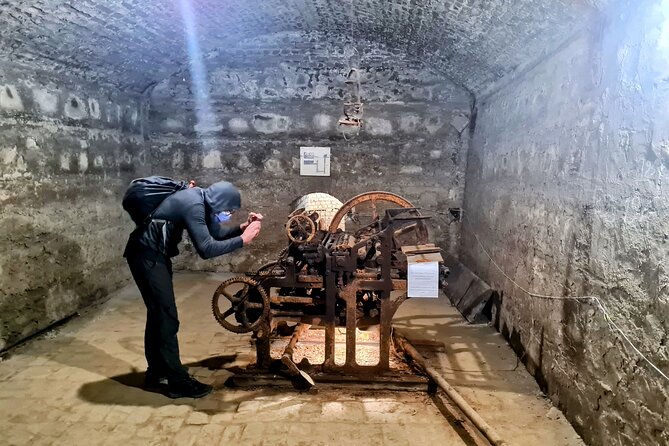
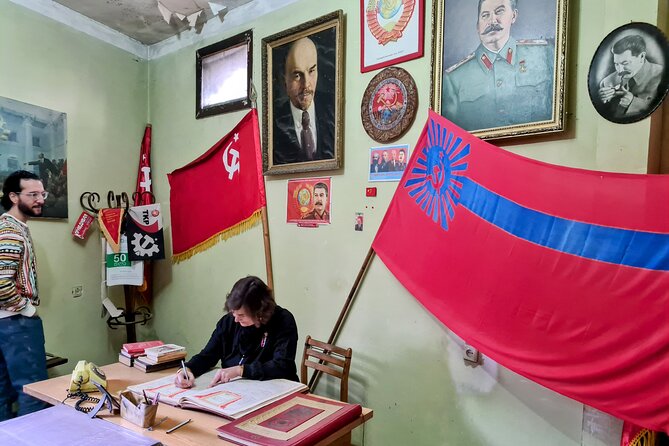
The first major stop is the J. Stalin Underground Printing House Museum, located below an old private home. The setting is part of the experience. Rather than walking into a grand state museum, you enter a compact, unusual space tied to clandestine Communist activity.
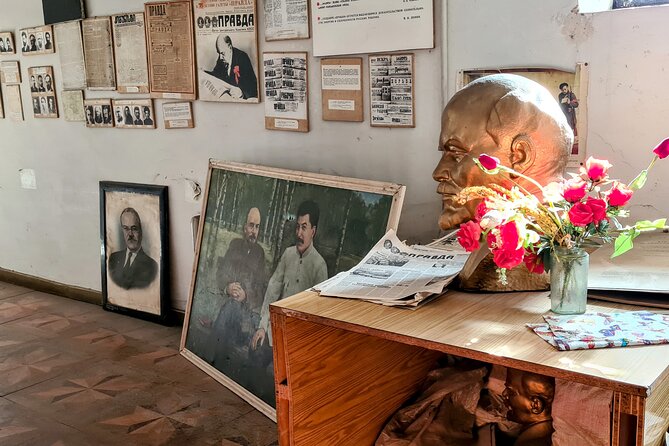
The press was used to produce illegal revolutionary material during the Russian Empire. The museum focuses on Stalin’s connection to the site and displays Soviet-era relics. Its director is described as a committed communist, which gives the visit an unusual human edge. You are not receiving a neatly packaged version of the past from behind a glass desk. You may hear a point of view that remains personally and politically invested.
That makes this stop especially useful for understanding how memory works in Georgia. Soviet rule is not an abstract chapter here. It affected families, institutions, language, work, and public life. The museum offers a direct entry into that world, even if its presentation may feel old-fashioned compared with a modern European museum.
The planned visit lasts about 30 minutes, with admission included. That is enough time to see the main objects and hear the story without letting one small museum dominate the afternoon. The basement setting can feel cramped and surreal, so anyone who prefers spacious, polished museums should set expectations accordingly.
The Chronicles of Georgia above Tbilisi Sea
From the printing house, the tour moves toward the Chronicles of Georgia, a vast monument by sculptor Zurab Tsereteli. It is often compared to Stonehenge because of its scale and arrangement, though the subject is distinctly Georgian.
The tall stone-and-metal columns depict episodes and figures connected with Georgia’s past, including religious and national themes. The monument remains unfinished, which adds to its force. You see an enormous project frozen between ambition and completion, set on a hill above the Tbilisi reservoir.
The view is one of the reasons this stop works so well. From the hill, you can look across the water and down toward broad fields of Soviet apartment blocks. The monument and housing districts belong to different parts of the city, yet together they show how public space was used to tell official stories and house large populations.
You have about 30 minutes here, and admission is free. That short visit is sensible if the weather is good and you mainly want the monument, views, and an explanation from your guide. Bring a phone or camera, because this is one of the best stops for wide photographs.
The site is exposed and monumental rather than intimate. If you want detailed museum displays, there is not much to read or handle here. Its value comes from scale, position, and context. Your guide’s explanation helps turn a collection of giant slabs into a place connected with Georgian identity and the Soviet-era impulse toward grand public art.
Nutsubidze’s skybridge and concrete housing
The longest part of the tour is devoted to Nutsubidze Skybridge, with about two hours allotted to the area. This is where the experience becomes urban exploration rather than a standard museum visit.
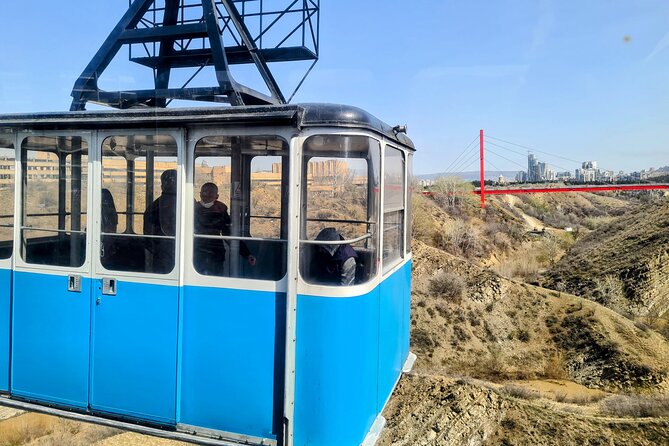
The skybridge is a striking piece of Soviet residential design. It links apartment blocks on a steep hillside and helps residents move between different levels of the complex. The structure has the rough, practical look associated with late Soviet construction, yet it also feels like an architectural puzzle. The result is visually unusual and excellent for photographs.
You will see more than one bridge. The surrounding area reveals the scale of the housing project, from concrete towers to access routes built into the slope. Your guide can explain how these developments fit into Tbilisi’s growth and how people use them. The point is not simply that the buildings are strange. It is that Soviet architecture often tried to solve real problems with large, engineered systems, even when the result now looks worn or improbable.
This is the part that will suit photographers and architecture fans best. It also gives you a closer look at residential Tbilisi, far from the restored streets most people see first. You may find peeling surfaces, rusty metal, and neglected corners. Those details are part of the visual character, but they also mean you should wear comfortable shoes and pay attention to your footing.
The longer time here keeps the visit from becoming a quick drive-by. You can look at the structures from different angles, take photographs, and ask questions without being rushed. That said, two hours focused on housing blocks and infrastructure may feel long if your interest in Soviet design is limited.
Same mountains, a completely different kind of day:
- Day Trip to Mtskheta Gori and Uplistsikhe
★ 5.0 · 1,801 reviews - Tbilisi Walking Tour Including Cable Car and Traditional Bakery
★ 5.0 · 1,310 reviews - Day Trip to Armenia Including Homemade Lunch
★ 5.0 · 1,162 reviews - Kakheti Wine Region: Signagi and Bodbe Tour with 10 Wine Tastings
★ 5.0 · 1,019 reviews
Extra architectural stops may add context
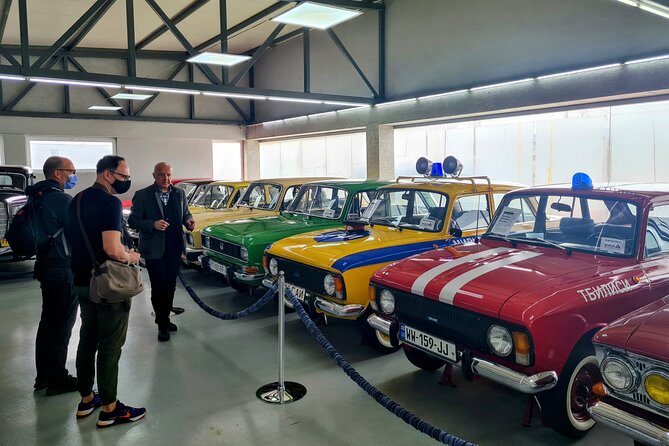
The core schedule names three main sites, but the experience can include additional architectural or historical points along the route. The information connected with the tour refers to the Bank of Georgia building, a Soviet car museum, and an archaeology museum as parts of some outings.
These additions are not presented as guaranteed fixed stops, so you should ask your guide what is planned on your date. If included, they help broaden the day beyond Stalin and monumental architecture. The Bank of Georgia building is especially useful for anyone interested in bold Soviet-era construction, while a car museum offers a more personal and everyday angle on the period.
This flexible quality is one of the private tour’s strengths. Your guide may spend more time on architecture if that is what interests you, or explain political events and personal experiences in greater detail. The tradeoff is that the exact mix can vary. If a specific building or museum is important to you, confirm it before setting out.
What the guides add to the experience
The guide matters a great deal on a tour like this. Concrete buildings do not explain themselves, and a giant monument can be difficult to read without background.
The guides named in the tour material include Temo, Zezva, Irakli, George, David, and Data. George is noted for his strong command of the subject, friendly manner, and good English. Temo is described as warm and approachable, with a clear love for Georgia. David is praised for connecting the sites with current affairs, culture, and personal context.
Those details point to the best reason to choose a private outing: conversation. You can ask why Soviet buildings look the way they do, how Georgia relates to Stalin today, or what changed after independence. The guide can also give you space when you want to photograph a building instead of talking.
English is the offered language. The tour is for your group only, rather than a shared group with strangers. That should make the five-hour schedule more comfortable, especially if your group has mixed interests or wants to move at a relaxed pace.
Is $49.68 good value?
At $49.68 per person, this is a fair price for a private, guided outing lasting roughly five hours. The value improves if two or more people share the booking, since hotel pickup, transport between distant parts of Tbilisi, and a dedicated guide are built into the experience.
The price also saves you the work of arranging separate taxis to the outer districts. You could visit some of these places independently, but connecting an underground museum, the Chronicles of Georgia, and Nutsubidze would take planning. You would also miss much of the political and architectural context.
Admission to the Chronicles of Georgia is free, while the printing house and skybridge portion are included in the tour price. The key value is not a long list of paid tickets. It is access, interpretation, and a route that would be difficult to assemble efficiently on your own.
For a single person, $49.68 is still reasonable if you place a high value on history and architecture. For someone mainly interested in food, old churches, or relaxed neighborhood walks, the same price may be better spent elsewhere.
Timing, pickup, and the practical details
The tour takes about five hours. Hotel or holiday apartment pickup is available for private groups, but you need to provide those details when booking. The stated meeting point is the round fountain near Avlabari metro station, and the listed end point is the Dry Bridge Flea Market on Zviad Gamsakhurdia Right Bank.
The finish is convenient. Dry Bridge is close to central Tbilisi and gives you a chance to continue browsing local stalls after the tour. If you prefer to return directly to your hotel, confirm the drop-off plan with the provider.
The tour is offered in English and is near public transportation. Most people can take part, though the route includes old buildings, hillside housing, and outdoor monument grounds. I would choose sturdy shoes and clothing suited to the weather. The itinerary includes a basement, open hills, and residential structures, so conditions will not feel like a controlled museum visit.
Free cancellation is available up to 24 hours before the start time for a full refund. A minimum number of participants may apply, and if the provider cancels for that reason, you are offered another date or experience, or a full refund.
Who should book this Tbilisi tour?
I would choose this experience if you have already seen the old town, or if you want to understand Tbilisi beyond its most familiar sights. It is a strong match for people interested in Soviet politics, architecture, photography, urban planning, or Georgia’s recent past.
It also suits a first visit if you have only one free afternoon and want a broad look at the city. The route covers distant districts and gives you a sense of how Tbilisi extends beyond the historic center.
I would not choose it for young children unless they are genuinely interested in buildings and history. The underground museum may be fascinating to some children, but the long focus on concrete housing and political context may test short attention spans.
The same applies if you want a gentle, scenic outing. The Chronicles of Georgia offers a fine view, but much of the day is about worn infrastructure, unfinished art, and complicated memory. That is rewarding, but it is not conventionally pretty.
Should you book Soviet Tbilisi Tour?
Book it if you want the city’s stranger, less polished side. The underground printing house gives the tour a memorable start, the Chronicles of Georgia supplies scale and views, and Nutsubidze provides an extraordinary look at Soviet residential design.
The private format, hotel pickup, English-speaking guide, and five-hour route make the $49.68 price sensible. Ask in advance which guide and extra stops are planned, especially if the Bank of Georgia building, car museum, or archaeology museum matters to you.
If your idea of Tbilisi is limited to old streets and traditional food, this tour may change the picture in the best way. It is not for everyone, but for a curious visitor, it can explain how the city became the complicated place you see today.
FAQ
How long does the Soviet Tbilisi Tour last?
The tour lasts approximately five hours, including visits to the underground printing house, the Chronicles of Georgia, and Nutsubidze Skybridge.
How much does the tour cost?
The listed price is $49.68 per person. Group discounts are offered.
Is this a private tour?
Yes. Only your group participates, and the guide can give your party direct attention.
Is hotel pickup available?
Yes. Pickup is offered from your Tbilisi hotel or holiday apartment for a private tour. You need to provide the accommodation details when booking.
What language is the tour offered in?
The tour is offered in English.
Where does the tour finish?
The stated end point is the Dry Bridge Flea Market at 3 Zviad Gamsakhurdia Named Right Bank in Tbilisi.
Can I cancel for a full refund?
Yes. You can cancel at least 24 hours before the experience start time for a full refund. Changes or cancellations made less than 24 hours before the start time are not accepted.
Just added around Tbilisi
- Private Adorable City Tour of Tbilisi★ 5.0 · 3 reviews
- Old tbilisi walking tour & wine tasting★ 5.0 · 9 reviews
- Tbilisi Airport to Gudauri, Bakuriani, Batumi, Tbilisi★ 5.0 · 3 reviews
- Your unique photo session in Tblisi, Georgia★ 3.5 · 4 reviews
- full day Kazbegi-Gudauri-jvari -from Tbilisi★ 5.0 · 6 reviews
- Wine promenade in hospitable Tbilisi★ 5.0 · 17 reviews
- Vardzia. Lake Paravani, Khertvisi & Lomisa castle, Rabati★ 4.5 · 12 reviews
- Wine Tasting Tour in Georgia’s Cradle of Wine★ 5.0 · 12 reviews
Tours, compared.

Highlights of Caucasus Mountains-Jinvali,Ananuri,Gudauri,Kazbegi(Group tour)
Read our review →
Tbilisi Walking Tour Including Cable Car and Traditional Bakery
Read our review →
Kakheti Wine Region: Signagi and Bodbe Tour with 10 Wine Tastings
Read our review →
Evening Walking & Talking Tour with Wine & Boat Ride
Read our review →
Kutaisi Canyons and Caves from Tbilisi Full Day Tour
Read our review →
Kazbegi and Gudauri Full Day Private Tour from Tbilisi
Read our review →
Diamond bridge and Dashbashi canyon day excursion from Tbilisi
Read our review →