Reviewed · TBILISI TOURS
Brutal Tbilisi: Urban exploration and untold stories
Tbilisi’s most revealing buildings are often far from its pretty balconies and cobbled Old Town. This four-hour trip takes you to Soviet brutalist landmarks, an abandoned museum, refugee housing, and skybridges high above the city, tying architecture to Georgia’s difficult recent past.
I like the way the tour connects buildings to people, especially at the former student dormitories now used by displaced families. I also like the unusual access at Nutsubidze Skybridge, where you may meet the local lift operator known affectionately as the lift lady.
The main consideration is pace and access. You need moderate physical fitness, and the former Archaeology Museum is abandoned rather than polished or museum-ready. Communication also depends on your guide, with one reported complaint about unclear answers in English.
In This Review
- Key points before you book
- Why Brutal Tbilisi changes how you see the city
- Starting at Rose Revolution Square
- The Ministry of Highways and Soviet ambition
- The Chronicles of Georgia on its hilltop
- The former Archaeology Museum, where the mood turns eerie
- Maglivi Bridge and the lives behind the concrete
- Walking 70 meters above Tbilisi at Nutsubidze Skybridge
- Group size, transport, and the value of $75
- Who will enjoy this adult-focused experience
- Booking details worth knowing
- Should you book Brutal Tbilisi?
- FAQ
- How long does Brutal Tbilisi last?
- How much does the tour cost?
- Is the tour offered in English?
- Where does the tour start?
- Where does the tour end?
- Is hotel pickup included?
- Is lunch included?
- What is the group size?
- Do I need to be physically fit?
- Can children join the tour?
- Can I cancel for a refund?
Key points before you book
- The Ministry of Highways building offers one of Tbilisi’s best examples of bold Soviet concrete design.
- The Chronicles of Georgia combines huge carved pillars with wide views over the city and reservoir.
- The former Archaeology Museum adds an eerie, unfinished edge to the experience.
- Refugee housing near Maglivi Bridge brings politics and daily life into the architecture story.
- Nutsubidze Skybridge lets you walk across elevated bridges around 70 meters above the ground.
- Guides such as Alex, Khato, Khatuna, and Aleksi are praised for linking architecture with Georgian history.
Why Brutal Tbilisi changes how you see the city
Most first visits to Tbilisi center on the old sulfur baths, churches, courtyards, and leaning wooden balconies. Those places matter, but they show only one layer of the capital. This tour shifts your attention to the city built during the Soviet period and the years after Georgia regained independence.
The word brutalist refers to a style that favors raw concrete, heavy forms, strong geometry, and practical function. In Tbilisi, that style often appears alongside older Georgian traditions, Soviet planning, hurried repairs, and the improvised life of the present day.
That mix is what makes the experience worthwhile. You are not simply driven around to photograph unusual buildings. You hear how these structures fit into Soviet education, transport, government, memory, displacement, and modern urban life.
I would choose this tour after spending time in central Tbilisi, not instead of seeing the Old Town. The contrast is the point. After admiring old balconies, you can look at concrete towers and ask what kind of city Georgia wanted to build in the twentieth century.
The tour costs $75 per person and lasts about four hours. That is a fair price if you value a local guide, transport between scattered sites, and access to places you would struggle to connect on your own. It is less compelling if you want a standard sightseeing loop or prefer to spend four hours inside conventional museums.
Other Tbilisi days people book alongside this one:
- Day Trip to Kakheti Wine Region Including 9 Wine Tastings
★ 5.0 · 2,774 reviews - Highlights of Caucasus Mountains-Jinvali,Ananuri,Gudauri,Kazbegi(Group tour)
★ 5.0 · 2,682 reviews - Day Trip to Kazbegi and Gudauri
★ 5.0 · 2,009 reviews
Starting at Rose Revolution Square
The meeting point is the Giant Bicycle monument at Rose Revolution Square. This is a practical central location near public transportation, though you should check the exact position in advance because the square has several recognizable landmarks.
The experience is described as a driving and walking tour. That matters here. These locations are spread across Tbilisi, and walking between them would waste much of your day. Transport also gives you time to see how the city changes from central districts to university areas and high residential zones.
Bring water, comfortable shoes, and clothing suited to the weather. Bottled water is included, but lunch is not, so eat beforehand or plan food for after the tour. The schedule allows roughly 30 to 45 minutes at each main stop, with travel time connecting them.
The tour is offered in English. Several guides are associated with the experience, including Alex, Khato, Khatuna, Aleksi, Alexi, and Iona. The strongest praise centers on their ability to explain both architecture and Georgian history in an approachable way. One guide was described as an encyclopedia on legs, which gives you a good sense of the information-heavy nature of the trip.
The Ministry of Highways and Soviet ambition
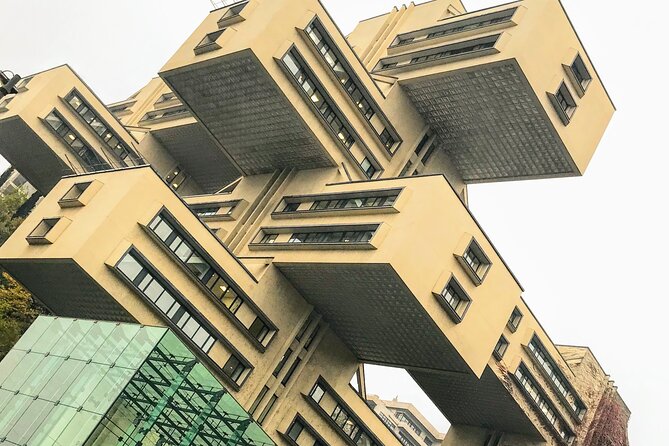
The first major stop is the former Ministry of Highways of the Georgian SSR, now associated with the Bank of Georgia building. It is one of Tbilisi’s signature brutalist structures, built from stacked concrete forms that seem to balance against one another.
From a distance, the building looks almost like a collection of giant blocks suspended in space. Up close, you can study the sharp angles, repeating patterns, and tension between mass and openness. This is not delicate architecture. It was designed to project strength, efficiency, and confidence.
The guide helps put the building into context. Soviet public architecture was meant to serve a practical purpose, but important buildings also carried political meaning. Government offices had to look durable and modern. Their scale told you that the state could organize enormous projects.
Allow about 30 minutes here. That is enough for an explanation, photographs, and a close look at the structure without letting the opening stop consume the whole morning. If you are an architecture fan, you may wish for longer, but the tour has several more demanding locations ahead.
The building is a strong introduction because it gives you the visual vocabulary for the rest of the day: concrete, repetition, monumental scale, and a mix of function and theater.
The Chronicles of Georgia on its hilltop
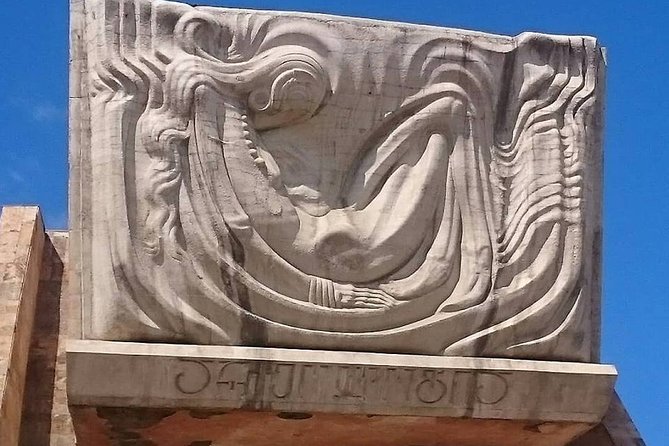
The Chronicles of Georgia, also called the Memorial History of Georgia, changes the mood. Instead of a government office, you encounter a huge hilltop monument made from massive stone pillars carved with scenes from Georgian history and mythology.
The monument is free to enter, and the planned stop lasts about 45 minutes. Give yourself time to walk around the pillars and examine the reliefs. The carvings refer to the founding of Georgia, religious change, ancient civilizations, and national legends.
The size can be hard to grasp in photographs. From ground level, the pillars feel severe and almost cinematic. Their location above Tbilisi adds to the effect, with broad views toward the city and the water below.
This stop is not pure Soviet brutalism in the same way as the Ministry of Highways building. It is better understood as monumental architecture shaped by national identity. That distinction is useful. The day is not a narrow lesson in one architectural style. It is about how governments and societies use large structures to express power, memory, and belonging.
Your guide can connect Soviet-era monument building with Georgia’s older cultural traditions. That makes the stop more than a photo break. You begin to see that concrete and stone can carry arguments about who a nation is and how it wants to be remembered.
Wear shoes with a secure grip. The hilltop setting and walking around the monument call for more effort than a quick roadside stop.
Same mountains, a completely different kind of day:
- Day Trip to Mtskheta Gori and Uplistsikhe
★ 5.0 · 1,801 reviews - Tbilisi Walking Tour Including Cable Car and Traditional Bakery
★ 5.0 · 1,310 reviews - Day Trip to Armenia Including Homemade Lunch
★ 5.0 · 1,162 reviews - Kakheti Wine Region: Signagi and Bodbe Tour with 10 Wine Tastings
★ 5.0 · 1,019 reviews
The former Archaeology Museum, where the mood turns eerie
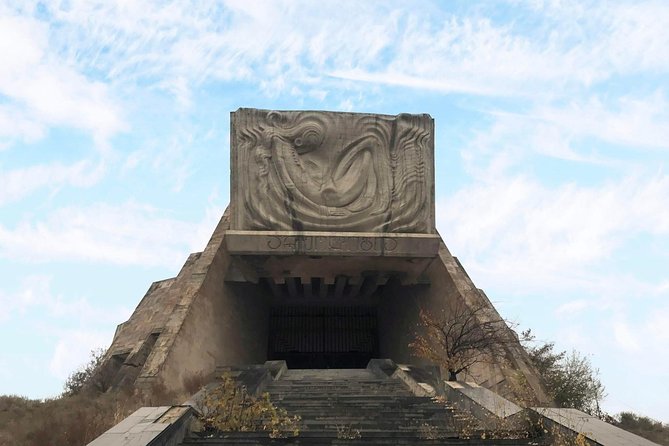
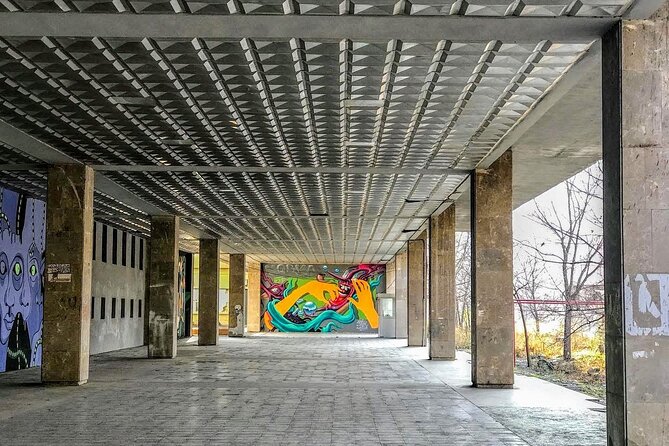
The former Archaeology Museum is one of the most unusual parts of the tour. Once a grand institution, it is now abandoned, giving the building an atmosphere that is very different from a functioning museum or restored historic site.
The planned visit lasts about 30 minutes. You can expect a look at the architecture and the building’s forgotten spaces, with the guide explaining its former role and significance. The attraction is as much about absence as it is about design. Empty rooms and aging surfaces show what happens when public ambitions lose their funding, purpose, or care.
This stop is a good fit for curious adults who enjoy places with a rough edge. It is not the right choice if you expect a formal museum visit, clear exhibits, or a polished route. Conditions inside abandoned buildings can change, and you should follow your guide’s instructions rather than wander off for a photograph.
One family traveling with older parents found this stop less suitable for everyone, though the guide adjusted the pace and allowed some people to sit it out. That is useful advice. The tour can accommodate different energy levels to a degree, but the former museum may require more care than the other stops.
For many people, this becomes the day’s most memorable location because it combines architecture, mystery, and the physical signs of a city moving on.
Maglivi Bridge and the lives behind the concrete
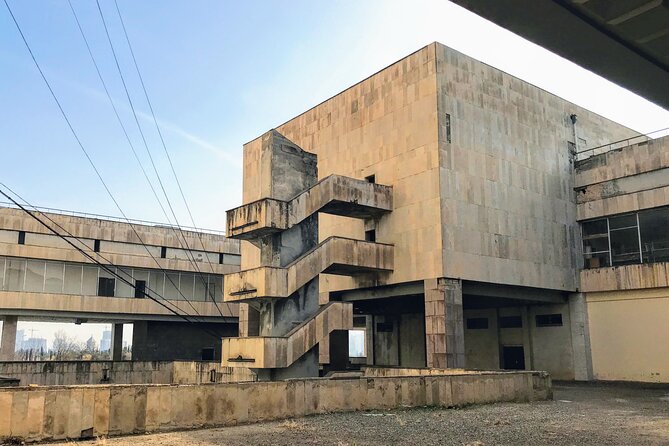
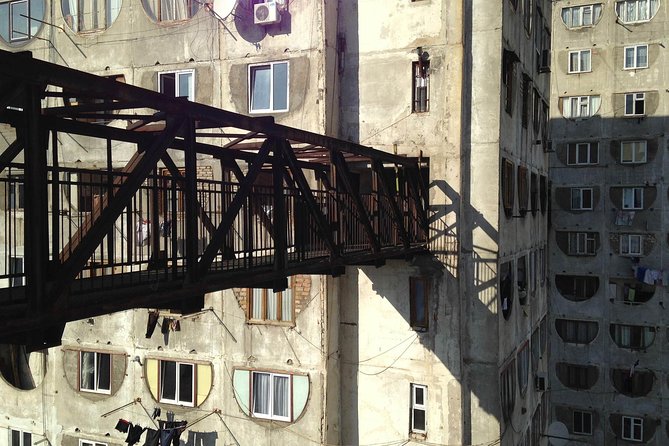
At Maglivi Bridge, the tour moves from striking buildings to the social consequences of urban change. You visit former student dormitories that now house refugees displaced from Abkhazia.
This is where the tour earns its title. The buildings are not treated as empty design objects. They are homes. Their current use tells you about conflict, displacement, and the long afterlife of political events.
The stop lasts about 30 minutes, and the guide’s tone matters. The strongest accounts of this experience emphasize sensitivity when discussing residents and the past. You should approach this part respectfully. It is not a theatrical ruin or a backdrop for careless photography.
The old cable car in the university district adds another layer. It was once a symbol of progress and modern urban transport. Today, it recalls an earlier vision of the city, when Soviet planners treated infrastructure as a sign of a better future.
I like this stop because it keeps the tour from becoming a parade of strange concrete shapes. You see how buildings age, change function, and absorb the pressures of real life. The architecture becomes a record of decisions made by governments, universities, and families.
Walking 70 meters above Tbilisi at Nutsubidze Skybridge
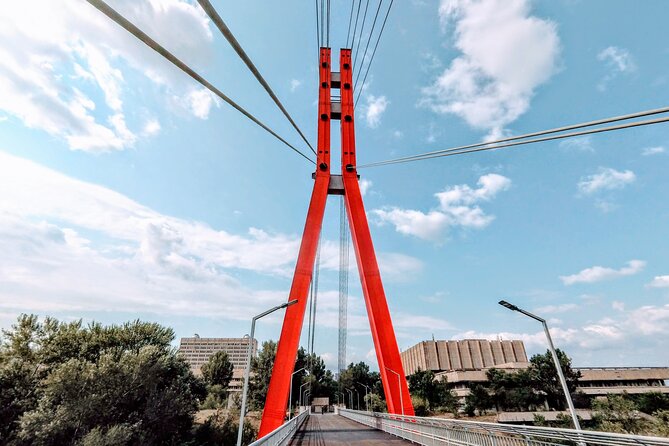
The Nutsubidze Skybridge is the grand finale. Twin residential towers are linked by elevated bridges, creating a distinctive arrangement that is both practical and visually startling.
The tour allows about 45 minutes here. You may have the chance to walk across the bridges, suspended roughly 70 meters above the ground. The views give you a different angle on Tbilisi, and the structure itself provides some of the best photographs of the day.
The skybridge is more than a dramatic walkway. It shows how Soviet architects tried to solve everyday problems in large housing districts. Connecting towers high above street level could shorten routes and create unusual shared spaces, though the experience today also reveals the wear of time.
A special moment may come at the elevator. The local lift operator, often called the lift lady, has become part of the experience for many visitors. Meeting her gives the building a human presence that photographs cannot provide. It also reminds you that these ambitious structures still function as part of ordinary residential life.
If heights make you uneasy, tell your guide. The tour includes walking and a high bridge, so this is not a minor detail. You can still appreciate the towers from below, but the elevated crossing is central to the stop.
Group size, transport, and the value of $75
The experience is promoted as a small-group tour, with one description giving a maximum of six people. The additional booking information lists a maximum of 14 travelers, so confirm the group size when you reserve if personal attention is important to you.
That distinction affects value. With six or fewer people, you are more likely to ask questions, adjust the pace, and hear detailed explanations without feeling rushed. A larger group can still work, but the experience may feel less personal at the archaeology site or inside residential buildings.
Hotel pickup is included only with private tours. The standard meeting point is Rose Revolution Square, and the tour ends back there. Some private arrangements have included airport drop-off, but you should not assume that service unless it is confirmed when booking.
At $75, I see the price as paying for three things: a specialist guide, transport to far-flung sites, and a route built around access and context rather than famous central attractions. Bottled water is included. Lunch is not.
This is good value for architecture fans, photographers, students of Soviet history, and anyone who has already seen the standard sights. It is less good value for a person who wants a relaxed city walk with cafés and shopping.
Who will enjoy this adult-focused experience
The tour is designed mainly for adults. Children may attend with an adult, but a family-friendly experience is recommended for younger children.
I would choose it if you:
- Like modernist or brutalist architecture.
- Want to understand Soviet and post-Soviet Georgia.
- Prefer unusual neighborhoods to the usual sightseeing circuit.
- Enjoy photography and large-scale structures.
- Are comfortable with driving, walking, stairs, and exposed viewpoints.
- Want a guide who can discuss politics, society, design, and history together.
I would think twice if you need step-free access, dislike abandoned buildings, or want every stop to be fully restored and open like a normal attraction. The route is about contrast and discovery, not comfort at every moment.
Guide quality matters here more than on a simple monument tour. Alex, Khato, Khatuna, Aleksi, and Iona are praised for warmth, flexibility, humor, and strong English. One complaint concerned repeated answers and a possible language issue, so if something is unclear, ask again early and directly.
Booking details worth knowing
Confirmation is provided when you book. The activity is near public transportation, and the ticket applies only to the date and time shown.
Free cancellation is available up to 24 hours before the start time for a full refund. Changes or cancellations inside that window are not accepted, with no stated exceptions.
Because the tour averages booking about 14 days ahead, reserve early if you want a private tour or a smaller group. Check the weather before leaving and dress for the conditions. The hilltop monument and outdoor bridge mean weather can affect comfort.
Should you book Brutal Tbilisi?
Book it if you want the Tbilisi that sits behind the postcard image. The Ministry of Highways, Chronicles of Georgia, former Archaeology Museum, refugee dormitories, and Nutsubidze Skybridge form a varied route, and the best guides connect each place to the lives and politics around it.
I would especially recommend it after a classic Old Town tour. You will understand the city better once you have seen both the ornate older quarters and the concrete ambitions of the Soviet era.
Skip it if you want a gentle, conventional sightseeing trip or if abandoned interiors and high walkways sound unpleasant. For everyone else, this is a sharp, unusual four hours, with enough architecture, history, and human detail to change the way you read Tbilisi.
FAQ
How long does Brutal Tbilisi last?
The experience lasts approximately four hours.
How much does the tour cost?
The listed price is $75 per person.
Is the tour offered in English?
Yes. The tour is offered in English.
Where does the tour start?
It starts at the Giant Bicycle monument at Rose Revolution Square in Tbilisi.
Where does the tour end?
The activity ends back at the meeting point.
Is hotel pickup included?
Hotel pickup is included only for private tours.
Is lunch included?
No. Lunch is not included, though bottled water is provided.
What is the group size?
The experience is promoted in one place as a small-group tour with a maximum of six people. The additional booking information gives a maximum of 14 travelers, so confirm the expected group size when booking.
Do I need to be physically fit?
You should have a moderate level of physical fitness. The tour includes walking, outdoor sites, and the Nutsubidze Skybridge.
Can children join the tour?
Children may attend if accompanied by an adult, but the experience is designed mainly for adults. A different family-friendly tour is recommended for younger children.
Can I cancel for a refund?
Yes. You can cancel at least 24 hours before the start time for a full refund. Cancellations or changes made less than 24 hours before the start time are not accepted.
Just added around Tbilisi
- Private Adorable City Tour of Tbilisi★ 5.0 · 3 reviews
- Old tbilisi walking tour & wine tasting★ 5.0 · 9 reviews
- Tbilisi Airport to Gudauri, Bakuriani, Batumi, Tbilisi★ 5.0 · 3 reviews
- Your unique photo session in Tblisi, Georgia★ 3.5 · 4 reviews
- full day Kazbegi-Gudauri-jvari -from Tbilisi★ 5.0 · 6 reviews
- Wine promenade in hospitable Tbilisi★ 5.0 · 17 reviews
- Vardzia. Lake Paravani, Khertvisi & Lomisa castle, Rabati★ 4.5 · 12 reviews
- Wine Tasting Tour in Georgia’s Cradle of Wine★ 5.0 · 12 reviews
Tbilisi Tours, compared.
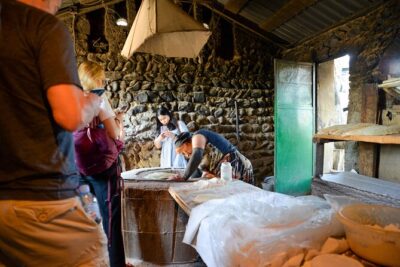
Day Trip to Kakheti Wine Region Including 9 Wine Tastings
Read our review →
Highlights of Caucasus Mountains-Jinvali,Ananuri,Gudauri,Kazbegi(Group tour)
Read our review →
Tbilisi Walking Tour Including Cable Car and Traditional Bakery
Read our review →
Kakheti Wine Region: Signagi and Bodbe Tour with 10 Wine Tastings
Read our review →